


Evolutionary biology has traditionally inferred process from patterns in extant organisms and the fossil record, leaving many foundational questions constrained by their historical nature.
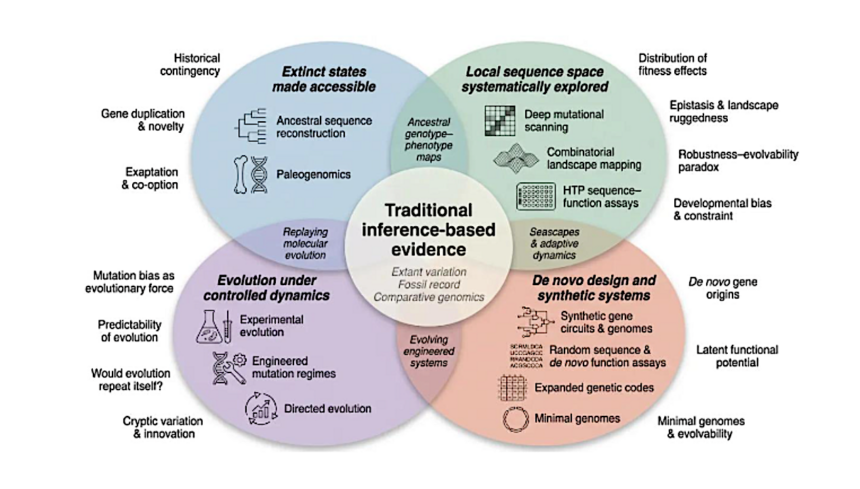
Over the past two decades, synthetic and high-throughput approaches — including deep mutational scanning, genome editing, ancestral sequence reconstruction, engineered mutators, and random-sequence assays — have made it possible to test these questions directly by constructing, perturbing, and replaying evolutionary systems.
Here, we review how these approaches reshape several foundational questions: the distribution of mutational effects, the structure and navigability of fitness landscapes, the evolution of evolvability, developmental constraint, historical contingency, and the engineering of evolutionary systems.
Across these domains, synthetic experiments are exposing unexpected mechanistic detail that refines and extends classical theory — revealing, for example, how strongly mutational effects depend on environmental and genetic context, how ruggedness can coexist with broad accessibility on fitness landscapes, how genotype–phenotype maps are intrinsically biased and heterogeneous, and how random sequences carry latent functional potential that may serve as raw material for later innovation.
As these technologies continue to expand the empirical reach of evolutionary biology, theory in turn sharpens the questions they are best suited to address — an iterative dialogue between experiment and theory that brings us closer to understanding how life evolves.
Synthetic biology as an empirical tool for evolutionary theory, ecoevorxiv.org (open access)
Astrobiology, evolution,
Biologist, Explorers Club Fellow, ex-NASA Space Biologist and Payload integrator, Editor of NASAWatch.com and Astrobiology.com, Lapsed climber, Explorer, Synaesthete, Former Challenger Center board member 🖖🏻
2026 © Reston Communications. All rights reserved.
Synthetic Biology As An Empirical Tool For Evolutionary Theory – astrobiology.com



Leave a Comment