




Amber from Myanmar’s Kachin region continues to reveal extraordinary glimpses into life during the age of dinosaurs. Preserved inside the 100 million-year-old resin are fossils from an ancient forest ecosystem that once supported a remarkable variety of creatures, including species never seen before.
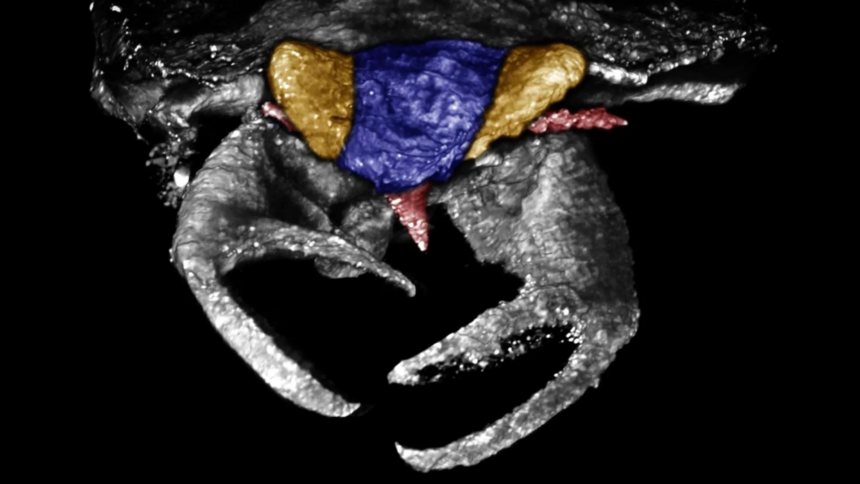
Now, researchers at Ludwig Maximilian University of Munich (LMU) have identified a newly discovered true bug (Heteroptera) with one especially unusual feature. Its front legs ended in large claw-like structures that resemble the pincers of crabs. These appendages, known as chelae, function much like forceps and are extremely uncommon among insects.
Ancient Insect With Rare Crab-Like Claws
"Previously, such chelae were known from only three insect groups. This fossil therefore represents the fourth known case of these structures evolving independently in insects," explains Privatdozent Carolin Haug, zoologist at LMU’s Faculty of Biology.
Haug and her colleagues worked with researchers from the University of Rostock and the University of Oulu in Finland to study the fossil in detail. Using micro-computed tomography, the team created highly detailed 3D images that allowed them to examine the insect’s anatomy. Their findings were published in the journal Insects.
The scientists also carried out a large morphological comparison involving more than 2,000 chelae and similar grasping appendages from both living and extinct species. Their analysis showed that the claws of this fossil bug were strikingly different from those found in other insects. Instead, the structures more closely resembled those seen in more distant arthropods such as decapods (crabs, lobsters, shrimps, etc.) and tanaids.
New Species Named After Stray Kids
Because of its highly unusual anatomy, the insect was assigned to an entirely new genus named Carcinonepa. The name combines the Latinized Greek term for "crab" (carcino-) with nepa, referencing the true water bug group Nepomorpha.
"The species name libererrantes is a Latinization of the highly successful K-pop group Stray Kids," explains Carolin Haug. "The name seemed fitting because the posture of the fossil’s chelae strongly resembles the group’s trademark pose. Stray Kids, I should add, is the favorite band of one of the paper’s authors, Fenja Haug."
Based on preserved physical traits, the researchers classified Carcinonepa libererrantes as part of the true water bugs (Nepomorpha) within the broader true bug group (Heteroptera). Aside from its dramatic claws, the insect’s body shares similarities with modern Gelastocoridae, also called toad bugs, which are land-dwelling predators.
A Tiny Predator From a Cretaceous Forest
"The morphology of C. libererrantes suggests that this species had a similar lifestyle," observes Carolin Haug. "We can imagine it living in a Cretaceous forest, probably near the coast."
Researchers believe the oversized chelae on its front legs were likely used to seize and hold small insect prey as it hunted through the ancient coastal environment.
Story Source:
Materials provided by Ludwig-Maximilians-Universität München. Note: Content may be edited for style and length.
Journal Reference:
Cite This Page:
Scientists Just Found Evidence That Asteroids May Have Helped Create Life on Earth
Scientists Create “Trojan Horse” Weight Loss Drug That Supercharges Results
Scientists Discover Major Errors in Al Gore-Founded Climate Pollution Database
Scientists Discover Grapes Can “Reprogram” Your Skin Against Sun Damage
Stay informed with ScienceDaily’s free email newsletter, updated daily and weekly. Or view our many newsfeeds in your RSS reader:
Keep up to date with the latest news from ScienceDaily via social networks:
Tell us what you think of ScienceDaily — we welcome both positive and negative comments. Have any problems using the site? Questions?
100-million-year-old bug had crab-like claws unlike any known insect – ScienceDaily



Leave a Comment

