




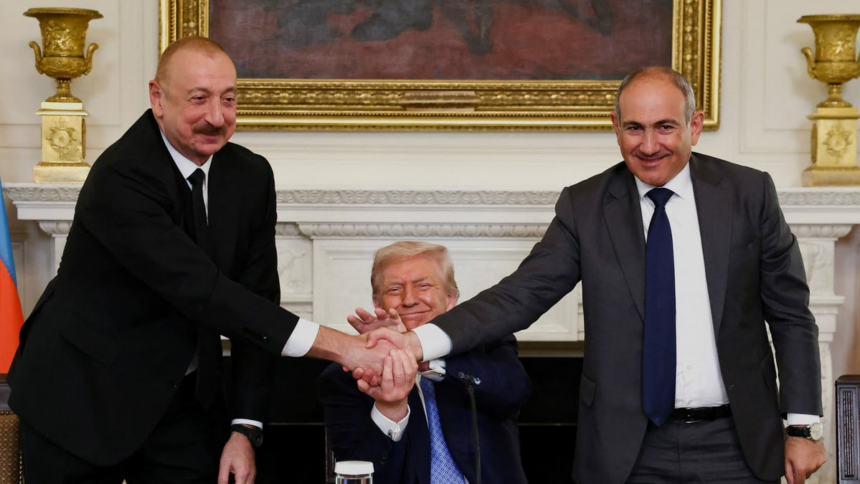
President Donald Trump’s legacy as a peace president is on the line. On June 7, Armenia will hold its first parliamentary elections since the Trump-brokered Armenia-Azerbaijan peace agreement in August 2025. Armenian Prime Minister Nikol Pashinyan’s Civil Contract Party has a wide lead in the opinion polls and is favored to win a plurality of seats. Nonetheless, nationalist angst over Azerbaijan’s military recapture of its Karabakh region in September 2023 and growing economic inequities will likely prevent Pashinyan from obtaining a parliamentary majority.
As Pashinyan edges toward an inconclusive election victory, Russia is intensifying its efforts to discredit him and derail his pro-peace agenda. By mobilizing local surrogates, corrupt oligarchs, and like-minded international actors, Russia seeks to establish its hegemony over Armenia and reignite its decades-long frozen conflict with Azerbaijan. If the Kremlin’s election interference campaign succeeds, the U.S. could suffer a major geopolitical setback and surrender its newfound influence in the strategically critical region of Eurasia.
Over the past decade, the Armenia-Russia treaty alliance has incrementally unraveled. As Pashinyan came to power through anti-government popular unrest in April 2018, the Kremlin viewed him with immediate suspicion. Armenia’s frustrations with Russia’s aloof response to Azerbaijan’s victorious 2020 and 2023 campaigns in Karabakh converted latent discontent into outright animosity.
As Armenia courted economic and security cooperation with Western powers, senior Russian officials publicly rebuked Pashinyan. This war of words intensified after Pashinyan declared in December 2024 that Armenia’s relationship with the Russian-led Collective Security Treaty Organization, or CSTO, had passed its “point of no return.” Sensing the evaporation of its influence over Armenia, the Kremlin doubled down on its historic alliance with Russia-friendly former President Robert Kocharyan and courted backers within the Armenian Apostolic Church, which has a history of cooperation with Soviet-era security services.
When ethnic Armenian Russian billionaire and Church mega-donor Samvel Karapetyan was arrested in June 2025, the wheels fell off the wagon of Russia-Armenia cooperation. Pashinyan accused Russia of using Karapetyan as a pawn in a “hybrid operation” against Armenia.
Karapetyan’s supporters accused Pashinyan of authoritarianism and began to mobilize politically. The result was Karapetyan’s creation of the Strong Armenia Party in December 2025, which has emerged as Pashinyan’s leading challenger in the parliamentary elections.
As the elections draw closer, Russia has sharpened its rhetorical and coercive knives. Former Russian President Dmitry Medvedev described Pashinyan and Ukrainian President Volodymyr Zelensky in the same breath as “brainless Russophobes.” Armenia’s hosting of the May 2026 European Political Community Summit and Pashinyan’s snub of the May 9 Victory Day celebrations in Moscow escalated tensions further. Russian President Vladimir Putin depicted Armenia’s courtship of European Union membership as incompatible with its current membership in the Russian-led Eurasian Economic Union and ominously warned of a “Ukraine scenario” if Armenia continued along its pro-European path. On Monday, May, 18, the Armenian Investigative Committee launched a probe into an alleged attempt to assassinate Pashinyan.
To augment its support for Kocharyan and Karapetyan, the Kremlin found international surrogates to further its destabilizing aims. One notable example is Luis Moreno Ocampo, former prosecutor of the International Criminal Court, and his son. According to video materials that circulated online in late April, the Ocampos are organizing campaigns aimed at removing Pashinyan from power and damaging the image of Armenia’s peace partner, Azerbaijan.
The pair is working with Armenian American lobbyists and members of the European Parliament to further their cause. These efforts align with Russia’s desire to restore power to sympathetic forces and facilitate the release of pro-Moscow Karabakh separatist clan leader Ruben Vardanyan from prison.
Mike Kelly: Stephen Colbert departs as Trump’s corrupt circus spins on | Opinion
Russia’s multi-pronged election interference campaign in Armenia is driven by much more than pique with Pashinyan. It is the latest chapter in a centuries-long geostrategic power play. By framing itself as the protector of Christian Armenians against the Persian and Ottoman Empires, the Romanov Tsars ensconced Russian hegemony over Armenia. After the Bolshevik Revolution and during the 1988-94 Karabakh War, Russia rallied in support of Armenians against their Azerbaijani and Turkish adversaries. As international sanctions and its full-scale invasion of Ukraine weakened its capabilities, Russia has surrendered its paternalistic role, and Armenia is on the cusp of fulfilling its age-old desire to decouple from Moscow’s imperialist yoke.
As its image of great power has been battered by military stagnation in Ukraine, Russia is desperate to reverse this trajectory and avoid being isolated in its own sphere of influence. If Pashinyan is re-elected, the Trump Route for International Peace and Prosperity (TRIPP) will connect Azerbaijan’s Nakhchivan exclave to Armenia. If TRIPP attracts sufficient international investment, it will emerge as the South Caucasus’s dominant transit corridor and derail Russia and China’s connectivity ambitions in the region.
It would also deal a crushing blow to Russia’s partner Iran. Under Kocharyan’s leadership, Iran used Armenian territory to smuggle military technology and Armenian banks to launder funds for the Islamic Republic. Pashinyan’s victory would deny Iran yet another lever of access to the international community at a time when its economy has been battered by war and sanctions.
The U.S. is on the cusp of either a strategic triumph or a crushing setback in the South Caucasus. If Armenian voters triumph over Russia’s dirty tricks, Trump’s foreign policy legacy will achieve a critical pre-midterm election boost.
Dr. Samuel Ramani is an associate fellow at the Royal United Services Institute, or RUSI, in London. He specializes in Russian and Eurasian foreign policy and global security and is the author of books including “Putin’s War on Ukraine” and “Russia in Africa.”
How Trump’s strategic legacy is threatened in the Caucasus | Opinion – Press & Sun-Bulletin



Leave a Comment

