


Explore
Current students
Services and information
May 22, 2026
Widespread student use of generative artificial intelligence (AI) is pushing educators to rethink how they teach and assess. Meanwhile, education leaders are grappling with how AI can support learning while preserving human judgment, academic integrity and relational connections.
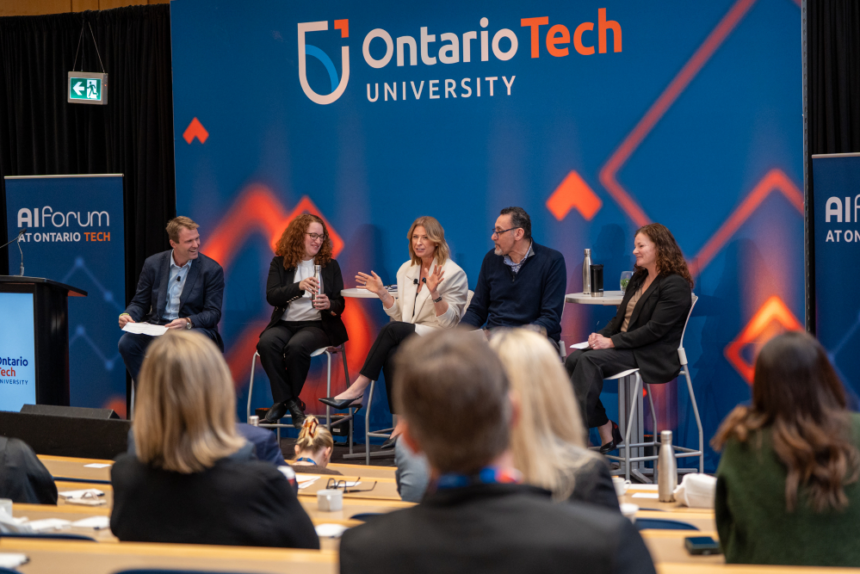
These issues were at the centre of Learning with AI: Opportunities and Ethical Challenges in Education, a panel at Ontario Tech University’s recent AI Forum. Moderated by Space Canada CEO Brian Gallant, the discussion examined how education systems are adapting to AI, and where they need greater clarity, transparency and responsibility.
What does ethical AI in education mean?
“I think of ethical AI in terms of core human values,” said Dr. Qusay Mahmoud, Professor and Assistant Dean of Engineering Outreach in Ontario Tech University’s Faculty of Engineering and Applied Science. “In academia, those include transparency, fairness, accountability and responsibility.”
For Dr. Amanda Cooper, Dean of Ontario Tech’s Frazer Faculty of Education, ethics begins with openness about AI’s use. “In many professional settings, we’re currently hiding AI’s use on all sides,” she said, emphasizing the need for greater transparency.
Sheri Williams, Managing Director, Accenture Industry X Canada, stressed moving beyond the typical ‘human in the loop’ practice, where people step in mainly to review or approve AI output, toward a model where people direct how AI is used from the outset. “We believe ethical AI is ‘human in the lead’, with AI there to support you,” she explained.
Actua’s CEO Jennifer Flanagan tied ethics directly to student impact, emphasizing the importance of using AI to deepen learning while safeguarding well-being and equity.
How will AI fundamentally change how students learn and teachers teach?
“Pre‑AI, students were out gathering information; they found it, retained it and gave it back to us on a test,” said Flanagan. “Post‑AI, the learning has shifted to critically thinking about whether the answer you’re given is right.”
Flanagan acknowledged concerns about declining critical‑thinking skills among students, and rising teacher stress as AI enters classrooms. She also emphasized the technology’s potential to support learners who need additional help.
“The opportunity for personalized learning is very real,” particularly for students who struggle with complex concepts or need to work at their own pace, she said.
What opportunities and challenges does AI present for personalized learning?
AI opens the door to new approaches to teaching and pacing student learning, Dr. Cooper said, noting AI tools can flag problems at a speed that could significantly change how educators intervene when students begin to struggle. This could enable earlier and more targeted support. “Not everyone would have to stay on the same topic for the same amount of time anymore,” she said.
But the reliability of an AI tool’s feedback varies by discipline, Dr. Cooper said, highlighting the need for careful judgment about when and how AI is used to support tutoring.
Dr. Mahmoud spoke to AI’s potential in large classes, where personalization has long been a challenge. He cautioned that issues such as student data privacy, fairness and accountability still need to be addressed.
How can education systems prepare students for an AI‑enabled world?
Williams pointed to industry’s ability to rapidly scale AI training. She encouraged education systems to leverage this work, adding that organizations are eager to collaborate.
She also suggested reframing AI as a tool rather than a threat, and emphasized the importance of teaching students where human judgment fits into AI‑assisted work, starting in elementary years. “Make sure they understand that they, not the AI, are accountable for the output.”
How should educators think about academic integrity in an AI‑enabled world?
Challenging the assumption that academic integrity should dominate the conversation, Dr. Cooper said, “The real question is: what kind of assessment actually promotes learning?”
Traditional assessments must change to reflect the reality that students are going to use AI. “If I ask for an essay on Lord of the Flies, AI is going to crank that out pretty quickly,” she said. “But if I’m using authentic assessment that deals with a real-world problem and that needs to use content from a course that has been delivered in class, plus students’ own experiences and other sources, it’s actually very difficult for AI to triangulate that. This moment is forcing us to rethink assessment, and that’s been a long time coming.”
How do we ensure AI enhances human connection rather than replacing it?
Strengthening human connection requires a shift in how educators approach their role in the classroom. “It’s no longer about showing up and delivering content,” said Dr. Mahmoud. “It’s about designing meaningful learning experiences.” Students should use AI to explore ideas while applying their own judgment, he added.
Flanagan shared an example of a Grade 12 English teacher using AI to design a collaborative Hamlet assessment. “The students are writing a screenplay together, they’re performing it, and each student has a role they have to embody,” she said. “That’s AI being used to drive human connection.”
What misconceptions persist about AI in education?
“One of the biggest misconceptions educators have is that AI is going to replace them,” said Dr. Cooper. “No one will ever replace the human understanding and connections with students at K-to-12 or higher-education levels. Relationships matter. Humans need to remain at the centre.”
“Some people think the biggest risk is academic integrity,” added Dr. Mahmoud, noting a related misconception that AI detection tools can reliably and fairly police cheating. “We should not be outsourcing academic judgment to AI detection tools. That leads to false accusations.”
From an industry perspective, Williams said AI’s treatment in the classroom often doesn’t align with the realities students face after graduation. “AI isn’t cheating,” she said, noting that in many workplaces, people are expected to use it from Day 1. While critical thinking remains essential, assessment needs to change to reflect that reality, she said.
Panelists also warned that students themselves can be overconfident in AI’s capabilities. “Many students think AI can replace thinking,” Dr. Mahmoud said. “AI is more of an amplifier. If students ask shallow questions, they’re going to get shallow answers.”
What’s the one message about AI educators should take away?
“Embrace it,” Dr. Cooper said. “Let’s innovate. Let’s fail forward. We’re not going to ‘policy’ AI out of existence.”
Flanagan called for a national strategy embedded in the federal AI approach to provide leadership and move AI literacy forward.
“Bring the outside in,” Williams said, adding that the integration of external perspectives will support critical-thinking skills development. “Real-world problems are messy and complicated, but that’s what people are going to have to solve when they enter the workforce.”
Ontario Tech launches new master’s degree for content creators
Ontario Tech to celebrate future-ready graduates at Spring Convocation
Government of Canada investment helps strengthen Canada’s defence capabilities
Ready for tomorrow’s careers.
We prepare our students for the fast-paced, ever-evolving world of technology.
Learn more
Help
Connect
Visit
Info
2000 Simcoe Street North
Oshawa, Ontario L1G 0C5
Canada
905.721.8668
Ontario Tech University is the brand name used to refer to the University of Ontario Institute of Technology.
© University of Ontario Institute of Technology . Ontario Tech and Design, and Tech with a Conscience are Official Marks of Ontario Tech University.
Ontario Tech acknowledges the lands and people of the Mississaugas of Scugog Island First Nation which is covered by the Williams Treaties and are the traditional territory of the Mississaugas, a branch of the greater Anishinaabeg Nation, including Algonquin, Ojibway, Odawa and Pottawatomi. Learn more.
Rethinking learning in an AI driven world – Ontario Tech University



Leave a Comment