


This is read by an automated voice. Please report any issues or inconsistencies here.
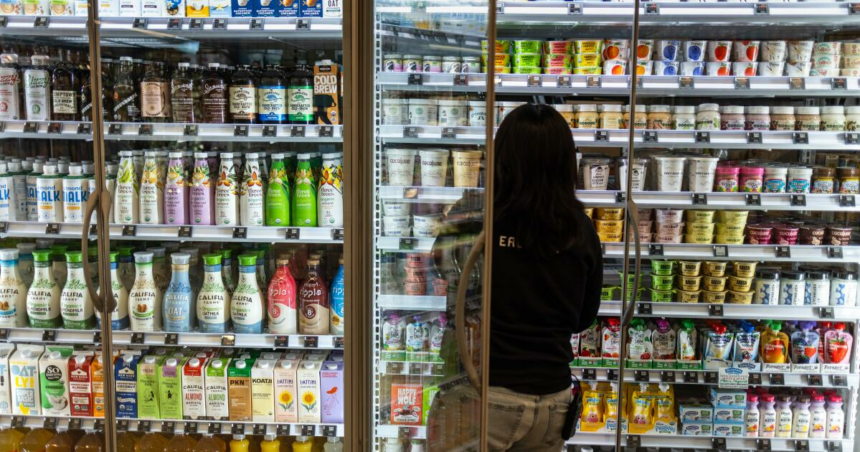
President Trump on Thursday announced that grocery stories and air conditioning companies will be allowed to keep using high-polluting refrigerants for longer than they would have under a law he signed during his first administration.
“This was a tremendous burden, a tremendous cost,” said Trump, surrounded in the Oval Office by executives from supermarket chains including Kroger, Fairway, Neimann Foods and Piggly Wiggly. “It was making the equipment unaffordable, and the actual benefit was nothing.”
The move loosens rules meant to restrict hydroflourocarbons, a class of climate-damaging chemicals used in cooling equipment. HFCs are known as “super pollutants” because their impact on climate change can be tens of thousands of times greater than carbon dioxide during their shorter lifespans.
In the move Thursday, the Environmental Protection Agency extends the deadline for companies to comply with a 2023 rule transitioning refrigerators and air conditioners off HFCs and onto new cooling technologies. Reducing these chemicals and moving to cleaner refrigerants has long been a bipartisan issue.
Trump is also proposing exemptions from a rule requiring leak repairs on large-scale refrigeration systems.
The administration framed the changes as part of its effort to bring down high grocery costs. EPA administrator Lee Zeldin said the actions will save $2.4 billion for Americans and safeguard 350,000 jobs.
“Americans who wanted to be able to fix their equipment were instead being required to buy far more costly new equipment and that just doesn’t make any sense,” said Zeldin.
David Doniger, senior attorney at the Natural Resources Defense Council, said the move will not only harm the climate, but U.S. competitiveness in global refrigerant markets as well.
“The EPA is catering to a small group of straggling companies by derailing the shift away from these climate super-pollutants,” he said. “The industry at large supports the HFC phasedown and has already invested in making new refrigerants and equipment, currently installed in thousands of stores.”
Danielle Wright, executive director of the North American Sustainable Refrigeration Council, an environmental nonprofit, said any perceived near-term savings from the rollbacks will be outweighed by the future costs.
“Business owners are far more worried about the escalating cost of keeping aging, high‑global-warming-potential equipment running than they are about the cost of installing new, compliant systems,” she said.
Trump dismissed the climate concerns, saying his changes “are not going to have any impact on the environment.”
He said he wants to get rid of the technology transition rule entirely in the future.
Follow Us
Blanca Begert is a climate and energy reporter for the Los Angeles Times.
Climate & Environment
California
Climate & Environment
Climate & Environment
Author and CBS News correspondent Jonathan Vigliotti attempts to answer some questions about rebuilding communities in his new book about the Palisades Fire — and names a motive for a quick rebuild: the Olympic games coming to Los Angeles in 2028.
Modern LA earned its first smoggy nickname 450 years ago, as the “bay of smokes.” At the La Brea tar pits, we take a short walk through a long history with curator Regan Dunn, who explains how and why the first Angelenos would have set fires that filled the broad bowl of LA and foretold the curse of smog.
Subscribe for unlimited access
Site Map
Follow Us
MORE FROM THE L.A. TIMES
Older AC and fridge chemicals amp up climate change. Trump just rolled back limits on them – Los Angeles Times



Leave a Comment