


Home / News / CSHL Stories and Media
Science comes first in STEM for good reason. Whether one pursues a career in technology, engineering, or medicine, all that work is rooted in scientific knowledge and experimentation. At Cold Spring Harbor Laboratory, education and research go hand in hand. That’s true at every level and applied in each initiative, including the CSHL Partners for the Future (PFF) program.
For more than three decades, the PFF program has mentored promising high school seniors from across Long Island. “It’s very important to train the next generation of students,” says PFF Director and CSHL Professor David Jackson. At CSHL, training goes beyond the classroom. “PFF students actively take part in cutting-edge research projects, working side-by-side with CSHL scientists.”
For PFF mentors, the experience is just as rewarding. “It’s been a lot of fun sharing my excitement for research with someone who’s equally interested and working on it with the same level of ownership,” says Dhivyaa Anandan, a graduate student in CSHL Associate Professor Camila dos Santos’ lab. “I hope that through this experience, we can show students how fun and creative science can be in such a collaborative environment.”
Since August 2025, Calhoun High School senior Sofia Ricci has spent a few afternoons each week at CSHL. And not only for the idyllic scenery, though that’s definitely a plus. Ricci is one of 12 seniors enrolled in the PFF Class of 2026. While high school extracurriculars typically revolve around sports, clubs, or theater, hers also include contributing to the dos Santos lab’s groundbreaking breast cancer research.
“When I stepped into the lab for the first time, I was overcome with excitement,” Ricci says. “I went from learning about things in textbooks to actually seeing and doing those things in real life. It was eye-opening, and Dhivyaa has been so supportive and encouraging.”
Most days, Ricci heads to the lab right after school lets out. Once she arrives, her assigned mentor, Anandan, will give her a rundown of the experiments they’ll run that day. Throughout the school year, there are many, each providing invaluable hands-on experience.
“It’s important to realize how different textbook biology can be from experimenting,” Anandan says. “Sometimes memorizing facts can feel very tedious. Thinking about a question yourself and figuring out how to answer it is very rewarding for students.”
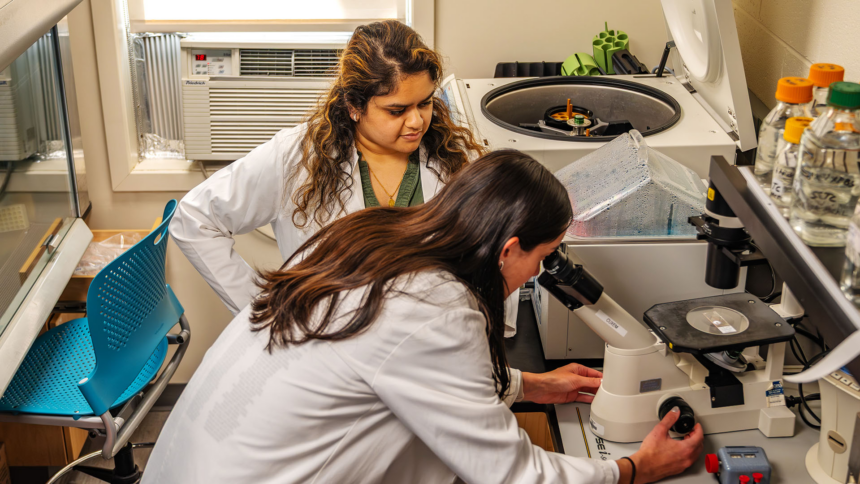
PFF students and their mentors share their experiences working together in CSHL’s state-of-the-art laboratories.
Ricci and Anandan’s project investigates probiotics’ impact on cancer development in mammary glands. Using patient tissue samples and mouse models, their research aims to reveal how diet influences tumor formation and structure.
As impressive as that sounds, it’s just one example of the kind of work PFF participants do every day at the Lab. Like Ricci, Stony Brook School senior Zhaojin (David) Guo starts the day meeting with his mentor, Vijina Varapparambath, a postdoc in David Jackson’s lab. There, the team focuses on Arabidopsis, a model organism central to plant biology research.
“Every day is different,” Guo says. “Sometimes I’m in the lab running PCR tests, preparing the gels we use in our experiments, or phenotyping specimens. Other days, I work at Uplands Farm in the greenhouse where we keep our seeds and potted plants.”
Guo and Varapparambath study mobile mRNA. In plants, cells communicate with each other via small channels called plasmodesma. The team focuses on how mRNA carries information between cells, and on the specific genes involved in the process. However, Guo’s work isn’t limited to a single research project.
“David has also been helping us streamline experiments,” Varapparambath adds. “He’ll notice something and say, ‘I have an idea to make this easier’ and come back a week later with a device or machine we can use. The whole lab has been impressed with him.”
For Guo, the feeling is mutual. “Even though my background was in engineering, I’ve been able to apply that to biology and genetics and gain a lot of knowledge,” he says. “Having a supportive mentor in that learning process has been tremendous.”
Since 1990, PFF has paired more than 200 young scientists with CSHL researchers. Students entering their senior year are nominated by their school’s science department chair. Through an interview process not too different from what they might expect after college, each candidate competes for the opportunity to join a lab specializing in one of CSHL’s primary research areas—cancer, plant biology and genomics, neuroscience, or quantitative biology and AI. Although some schools have a longer history with the program than others, it’s open to all.
“I’m only the second person from my school to be part of the program,” says Hicksville High School senior Shelby Fraser. “I’d been through summer science programs before, but nothing compared to PFF.”
While Fraser had always been into nature and the environment, the program offered a new and exciting opportunity to explore the biomedical implications of his interests. Working alongside mentor Liam Shanley, a grad student in Professor Chris Vakoc’s lab, Fraser was able to design his own project, ask questions about connections between biology and medicine, and bring his experiences to the team’s research.
“Working with Shelby is fun because, while he’s an exceptionally bright scientist, there’s still so much he doesn’t know yet just by virtue of being young,” Shanley says. “It’s been a nice reminder that everyone, me included, is allowed to not know things. He asks questions with such grace it reminds me to do the same.”
For Portledge High School senior Avery Joshua-Tor, doing research alongside CSHL Associate Professor Lucas Cheadle offered the chance to work at the intersection of biology, neuroscience, and artificial intelligence.
Joshua-Tor and Cheadle’s project explores mechanisms behind the placenta’s role in neurodevelopmental disorders. Using AI and coding to analyze experimental data sparked in Joshua-Tor curiosity about how such tools can be applied to other areas of research.
“I was able to see biological processes up close and how things like machine learning can be used for experiments,” she says. “Going forward, I definitely want to pursue this and make my model better than it is right now.”
“Avery is bright, ambitious, and curious—all fantastic qualities for a young scientist,” Cheadle adds. “She asks questions that are difficult to answer and cut to the core of biology. That’s a sign of an independent thinker, and it’s been a pleasure to work with someone with that level of talent and adaptability.”
For Cheadle, PFF’s value to students and mentors was clear from the start. In fact, when he was in high school, he took part in a similar program at the University of Oklahoma. Today, he credits this experience with kickstarting his career.
“That early exposure to science set me up for success,” he says. “When I got to college, I was able to join a lab quickly. Then, when I started my own lab, I was energized by working with younger folks because I had an opportunity to usher talented people into this world of research. It’s one of my favorite parts of working in science.”
After seven months of immersive lab work, students present their research to friends, family, and fellow scientists at CSHL’s PFF Symposium. Modeled on CSHL’s annual Symposium on Quantitative Biology, the PFF event features each student giving a 10-minute talk about their research, followed by a short Q&A.
For the students—who come to CSHL from different communities—it’s an opportunity to connect with like-minded teens while gaining invaluable experience in an area that can be daunting for even the most seasoned professionals: public speaking.
“The symposium is a check on my understanding,” Guo says. “When I present to a public audience, I want to make sure everything I’m talking about is true. On the other hand, I’m also looking forward to seeing all the other students and hearing about their adventures in the lab.”
Joshua-Tor agrees. “Everyone in PFF is engaged and passionate about what they’re doing,” she says. “It’s fun to be with people so curious, and it creates a great environment for asking questions. Plus, everyone’s working on different topics, from plants to cancer to neuroscience, so you learn a lot.”
For relatives and schoolteachers in attendance, the event can be even more eye-opening. “The students are doing cutting-edge research here at CSHL,” says Jackson. “Many people don’t realize how difficult that is and how important discoveries can make life better.”
Science is a lifelong learning process, Jackson adds, so it’s important to get students involved and excited early. Whether they come away from the program with co-author credits on published research or a better understanding of what the life of a scientist entails, they often head to graduation with a sense of direction that’s remarkable for someone their age.
That’s clear from listening to Ricci talk about her future plans. “I definitely want to pursue science in college,” she says. “Being here has made me realize how much I love working in a lab and working with tissues. I’ve been thinking about homing in on molecular biology or neuropathology and pursuing a Ph.D. from there.”
For at least one student, the next step on that journey has already been decided. “I recently committed to the University of Toronto on a scholarship,” says Fraser. “I’m not sure what I want to specialize in yet, but I definitely want to pursue biology. Undergrad is where you do much of the groundwork that sets up your Ph.D., and it’s great I have this experience. I think I’ll be able to get into a lab very, very early.”
Such confidence is not unfounded. Because PFF is designed with education and experimentation in mind, it enables students to approach college professors with research opportunities they might not have considered. Thus, it continues to further the frontiers of scientific knowledge, just as CSHL has done for more than 130 years.
So, if you want to know what the future of science holds, look to the people who will be doing that science.
Written by: Nick Wurm, Communications Specialist | [email protected] | 516-367-5940
Sign up for our newsletter to get the latest discoveries, upcoming events, videos, podcasts, and a news roundup delivered straight to your inbox every month.
Newsletter Signup
July 27, 2021
March 10, 2023
May 5, 2024
516-367-8800
[email protected]
1 Bungtown Rd, Cold Spring Harbor, NY 11724
Get Directions
Get the latest discoveries, upcoming events, videos, podcasts & a news roundup delivered straight to your inbox every month.
© 2026 Cold Spring Harbor Laboratory. All Rights Reserved.
Sitemap | Privacy Policy | Web Accessibility
Fostering the future of science – Cold Spring Harbor Laboratory


Leave a Comment