

Share article
Print article
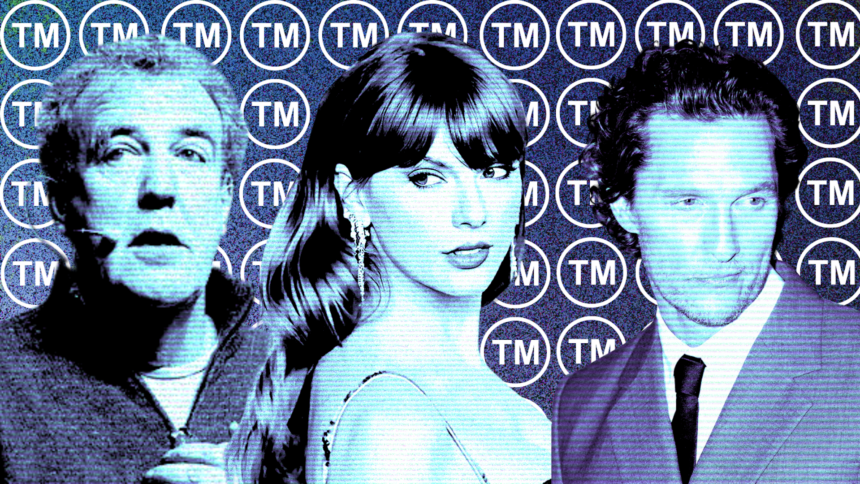
In recent months, celebrities such as Taylor Swift, Matthew McConaughey and Jeremy Clarkson have turned to trademark law to protect aspects of their identity associated with their brands.
It’s a relatively new legal tactic and not yet tested in court. But celebrities are using it in an attempt to fill a gap copyright law wasn’t designed to fill.
In late April 2026, Swift registered two sensory trademarks of her saying “Hey, it’s Taylor”, “Hey it’s Taylor Swift”, as well as a specific image from the Eras Tour.
McConaughey has been granted registration for eight trademarks depicting his face, voice and known catchphrases. These included a three-second motion mark of him sitting in front of a Christmas tree and a sound mark of his famous “All right, all right, all right” from the movie Dazed and Confused.
British TV presenter Clarkson trademarked an image of his face. This was in response to a series of fake AI social media posts in 2024 which depicted him endorsing cryptocurrency.
So why are celebrities suddenly registering trademarks in a bid to protect their identity? The answer, unsurprisingly, lies with generative artificial intelligence (AI).
Generative AI poses a growing threat to everyone’s identity: anyone can be the victim of a deepfake or voice clone.
For celebrities, the stakes are even higher, as AI makes it easier than ever to impersonate their image, voice or likeness. Serious reputational harm or fake commercial endorsement can happen because for many celebrities, their face and voice are their brand.
In the United States there are publicity rights which help to protect against unauthorised commercial use of identity. However, these are state-based, so they vary in scope and application. Australia does not have equivalent laws.
For celebrities, registering trademarks provides another avenue of legal protection. And trademarks are federal, rather than state based.
McConaughey said his trademarks would serve two purposes – protect his brand from unauthorised AI cloning, and provide him with future agency over the use of his voice or likeness.
To understand this better, let’s unpack what trademarks are and how they differ to copyright law.
A trademark is a distinctive logo, word, slogan, shape, letter, number or colour which distinguishes the identity of a brand. Who doesn’t recognise the golden arches that mark the “M” for McDonald’s?
There are also non-traditional trademarks – known as “sensory marks”. These can be sounds, scents, texture or taste. All marks require registration and focus on consumer recognition of a brand and the avoidance of brand confusion.
Contrast this to copyright, which applies to creative works such as books, songs, sound recordings and videos. If particular criteria are met, protection arises automatically.
Traditionally, creators have relied upon copyright to protect their music, photos and videos. But the way AI works can make that tricky.
Although AI-generated material might be trained on pre-existing recordings, images and videos, the output usually synthesises the training material. For copyright infringement of creative works to be found, it first must be proven the defendant had access to the original work.
Then, it must be determined how “substantially similar” the alleged infringement is to the original work. This involves a series of tests in court, and may involve witness testimony. There must also be a sufficient and recognisable resemblance between the work and the alleged infringement.
AI can produce a deepfake or voice clone of a celebrity that may not be found to be “substantially similar” to the original work because it was synthesised from many bits and pieces. This is where copyright law struggles – the original and the AI generated work might not be similar enough to say the AI material infringed on copyright.
And that’s why celebrities are turning to trademarks instead.
Importantly, celebrities are not trademarking their voice, face or performance generally. Rather, they’re tying particular aspects of their identity to the trademark – such as key phrases, images or performance elements – because it’s integral to their brand.
Trademark infringement works on a concept known as “likelihood of confusion”. This means the court will examine whether the alleged infringement is likely to cause confusion through a multi-factor test.
Unlike copyright, the alleged infringement only needs to be close enough to the trademark that people might think it’s connected or endorsed by the celebrity’s brand.
Now that Swift has trademarked a clip of herself saying her name, she may argue an AI-generated deepfake or voice clone that looks and sounds similar to that could confuse consumers into thinking it’s associated with her brand.
As these trademarks have not yet been tested in court, it’s uncertain whether they would be upheld. We don’t yet know the extent to which phrases and performance elements can denote brand. And how much AI replication would be sufficient to infringe? Trademark owners are also required to have made use of their marks, but how do you continuously use a catchphrase?
Although this is a novel tactic, trademarks are likely not a panacea to celebrity AI deepfakes or cloning. Nor will they help most people if their face or voice is cloned – after all, most of us don’t have a brand associated with our identity.
This is yet another example where AI is challenging people to be creative in adapting existing laws.
Senior Lecturer in Law, University of New England
Wellett Potter is a member of the Copyright Society of Australia and the Asia-Pacific Copyright Association.
University of New England provides funding as a member of The Conversation AU.
View all partners
https://doi.org/10.64628/AA.g9j7q4vgp
EYOP Postdoctoral Research Fellow/Research Fellow
Copyright © 2010–2026, The Conversation Media Group Ltd