news Alerts
There are no new alerts at this time
HONG KONG — As the crisis in the Strait of Hormuz drags on, guardians of another critical waterway are worried about the precedent it sets for any future clash between the United States and China.
Subscribe to read this story ad-free
Get unlimited access to ad-free articles and exclusive content.
“If they go to war in the Pacific, what you are witnessing now in the Strait of Hormuz is just a dry run,” Singaporean Foreign Affairs Minister Vivian Balakrishnan said last month.
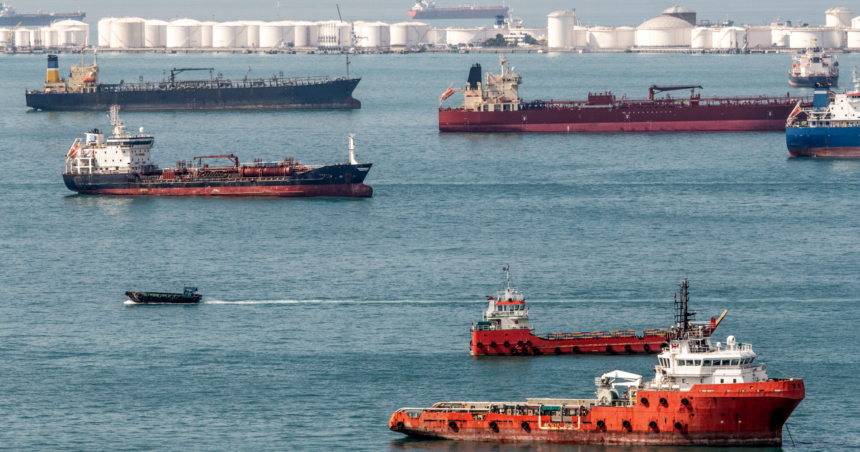
Singapore, Indonesia and Malaysia all flank the Strait of Malacca — a waterway roughly five times longer and 10 times narrower than the Strait of Hormuz at its tightest point. It carries more than a quarter of global trade, including most of the oil that flows from the Persian Gulf to key Asian markets.
Goods from China are heavily reliant on the strait, which links the Indian Ocean with the Pacific Ocean via the South China Sea, but it also serves as the primary energy lifeline for U.S. allies such as South Korea, Japan and the Philippines, making control of the waterway crucial in any future U.S.-China conflict.
For decades, the U.S. has maintained a strong naval presence across the region, with the U.S. Navy’s 7th Fleet having played an active role during several wars in Asia, including in Korea and Vietnam. Its constant presence has long irked leaders in China, whose own navy has undergone rapid modernization and is now the largest in the world.
With the two global superpowers in proximity to the strait, the question is whether a Hormuz-style showdown could one day happen here too.
“If I was the admiral, I would shut down Malacca,” said Sean Andrews, a retired Australian naval captain, referring to a hypothetical future U.S. conflict with China. “In any potential crisis, Malacca will be a gatekeeping operation of sorts.”
“Certain ships would be allowed to go through, and certain ships wouldn’t be allowed to go through,” he said.
Any disruption to the strait would force vessels on costly dayslong detours. Ships would have to reroute further south, through the Lombok Strait, around the Java Sea near Jakarta, or bypass the Indonesian archipelago entirely. “It’s the quickest way through a geographical obstacle like Southeast Asia,” Andrews said.
However, potential disruption may not be as critical as the Hormuz crisis, which has left many Gulf states with effectively no route to the wider ocean. There are alternative routes for vessels if Malacca is blocked, meaning a closure could prove more of an inconvenience than an absolute barrier to trade.
Wary of any geostrategic vulnerability, China has spent decades seeking a solution to what former Chinese President Hu Jintao dubbed the “Malacca dilemma,” seeking to reduce its dependence on crude oil imports coming through the strait.
“The control over waterways has fundamentally changed” following the Hormuz crisis, said Christian Bueger, a professor at the University of Copenhagen and the author of “Understanding Maritime Security.”
“Freedom of navigation cannot be ensured anymore with big gunboats.”
The three countries flanking the strait have long had pragmatic relationships with both the U.S. and China, and have previously been aligned on the need for free trade to flow, though the Hormuz crisis has seen tensions erupt.
Inspired by Iran, Indonesian Finance Minister Purbaya Yudhi Sadewa briefly floated imposing a “toll booth” charge last month, though his government has since walked back the suggestion.
“We do not have tolls. All of us are trade-dependent economies,” Balakrishnan, the Singaporean minister, reiterated at a CNBC event in Singapore last month, while Malaysian Foreign Minister Mohamad Hasan stressed a “watertight understanding” that there could be no changes in the Strait of Malacca without involvement of all neighboring countries.
Defense Secretary Pete Hegseth last month announced a defense cooperation partnership with Indonesia, with a joint statement emphasizing a “commitment to cooperation based on mutual respect, sovereignty, and shared interest in regional peace and stability.”
Unlike the Strait of Hormuz, which lacks any formal arrangement among its surrounding countries for its management, the Strait of Malacca is governed by a series of agreements between Singapore, Malaysia, Indonesia and Thailand. These cover everything from coordinated maritime patrols and aerial surveillance to shared intelligence and environmental protection.
“Singapore is kind of a coordinator in this,” said Barbora Valockova, a research fellow at the Centre on Asia and Globalisation at the National University of Singapore.
The city-state was trying to make others in the region understand that “maybe the lesson from Hormuz is that it shows that we should even redouble our efforts to keep Malacca open, predictable and insulated as far as possible from wider geopolitical confrontation,” she added.
“With respect to both America and China, we have told both of them, we operate on the basis of UNCLOS,” Balakrishnan said, referring to the U.N. Convention on the Law of the Sea.
“The right of transit passage is guaranteed for everyone. We will not participate in any attempts to close or interdict or to impose tolls in our neighborhood.”
Mithil Aggarwal is a Hong Kong-based reporter/producer for NBC News.
© 2026 NBCUniversal Media, LLC