


Advertisement
A record-breaking new version of Starship, due to launch within days, could form the basis of NASA’s ambitious Artemis programme that aims to put humans back on the moon as soon as 2028
By Matthew Sparkes
15 May 2026

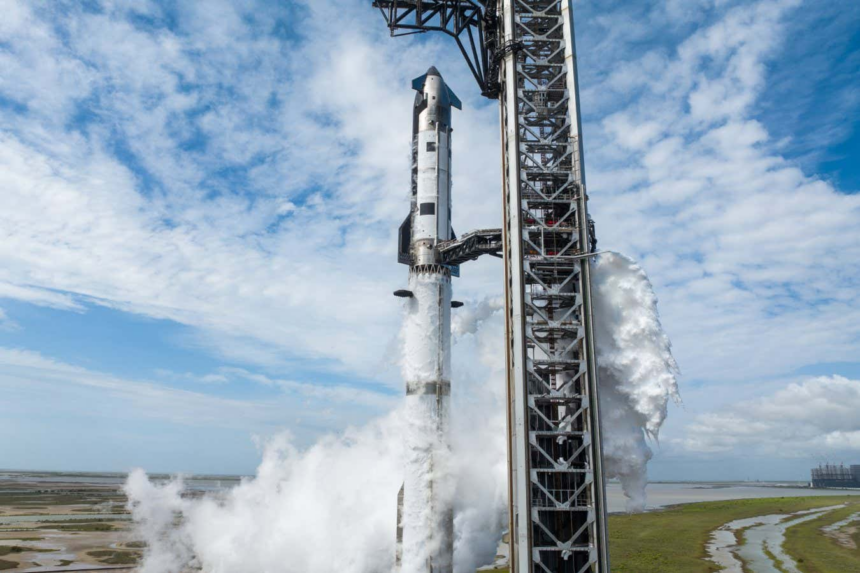
Starship on the launchpad at SpaceX’s Starbase in Texas
SpaceX
Starship on the launchpad at SpaceX’s Starbase in Texas
SpaceX
SpaceX will fly an extensively upgraded Starship next week that will – if it launches successfully – break records as the tallest and most powerful rocket in history. The flight will be watched keenly at NASA, as the craft is vital to its plans to put humans back on the moon in 2028.
Starship is made up of two parts: an upper stage, confusingly also called Starship, and a lower stage called Super Heavy. Since the last Starship test in October last year, SpaceX has been making extensive revisions to both stages.
Read more
Is an old NASA probe about to redraw the frontier of the solar system?
Advertisement
The twelfth test flight, which is expected to launch as soon as 19 May, will involve new version 3 models of both craft. Powering each stage will be version 3 Raptor engines, which have seen limited testing on previous flights, and the launch will take place from a newly designed pad at the company’s Starbase site in Texas, meaning that the stakes for the test are particularly high.
On Super Heavy 3, the number of grid fins, intended to steer it back through the atmosphere to a safe landing, has been reduced from four to three but their size is expanded by 50 per cent. Starship 3 has a new, larger propellant tank, equipment for in-orbit refuelling and improved heat-resistant tiles for atmospheric re-entry.
The total height of the rocket at launch will be 124 metres – about 1 metre taller than version 2 of Starship. Its height also surpasses the 98-metre-tall Space Launch System (SLS) rocket currently used by NASA and the 111-metre-tall Saturn V that sent astronauts to the moon in the 1960s and 70s.
Free newsletter
Bring the galaxy to your inbox every month, with the latest space news, launches and astronomical occurrences from New Scientist’s Leah Crane.
Starship 3 will also have 75,000 kilonewtons of thrust, which is almost twice the 39,000 kilonewtons of SLS, making it the most powerful rocket ever launched.
Alistair John at the University of Sheffield, UK, has calculated that the power of all the engines on the full Starship stack, at peak output, is larger than that produced by all electricity generation in Germany. “It’s massive,” says John.
Starship is being developed to put satellites in orbit and also ultimately to run missions to Mars, according to SpaceX CEO Elon Musk. But it has also been selected by NASA as one of two commercial lander designs for its Artemis programme to return humans to the moon, alongside a lander from Jeff Bezos-backed Blue Origin.
After an uncrewed Artemis I mission in 2022, the second Artemis flight earlier this year took four astronauts around the moon, further from Earth than any human has travelled before.
A recently released NASA document confirms that the Artemis III mission will see crew launch in an Orion spacecraft atop the SLS rocket into low Earth orbit and then rendezvous with “one or both commercial lunar landers provided by SpaceX and Blue Origin”. Such a manoeuvre will be needed to get crew and fuel aboard a lander ahead of a mission to land on the moon’s surface, with Artemis IV aiming to do this as early as 2028.
Read more
Why NASA is sending a probe to Europa – and what it’s looking for
SpaceX is using a fail-fast, learn-fast strategy more common in Silicon Valley than the conservative world of space exploration. Out of the 11 previous test flights, there have been six successful flights and five failures. Neither SpaceX nor NASA responded to a request for comment.
Peter Shaw at Kingston University London believes SpaceX is on track for the Artemis programme, despite previous failures. “Rocket science is difficult. It’s challenging. It’s complex,” says Shaw. “Can they do it? Yes. Can they do it within the timeline? There’s a lot to be quietly confident about. Even if you have another failure or two, or five… they’ll learn from it, they’ll iterate it and they’ll put a new system together.”
John says the upcoming Starship test will be important to verify the design of the version 3 craft that will form the basis of the the Human Lander System (HLS) that SpaceX intends to touch down on the moon. HLS will need significant alterations, such as different engines designed to touch down under the moon’s lower gravity, and no heat shield, as it will never have to withstand re-entry to Earth’s atmosphere.
“It’s in a way small, incremental improvements, but then also it’s by far the most significant version: this version 3 is what they need for the Artemis programme. The other ones have been prototypes,” says John. “Version 3 is really the first test of the production model. Now it’s just making it reliable.”
Topics:
Advertisement
Receive a weekly dose of discovery in your inbox. We’ll also keep you up to date with New Scientist events and special offers.
Explore the latest news, articles and features
News
News
Analysis
News
Trending New Scientist articles
Advertisement
Download the app