




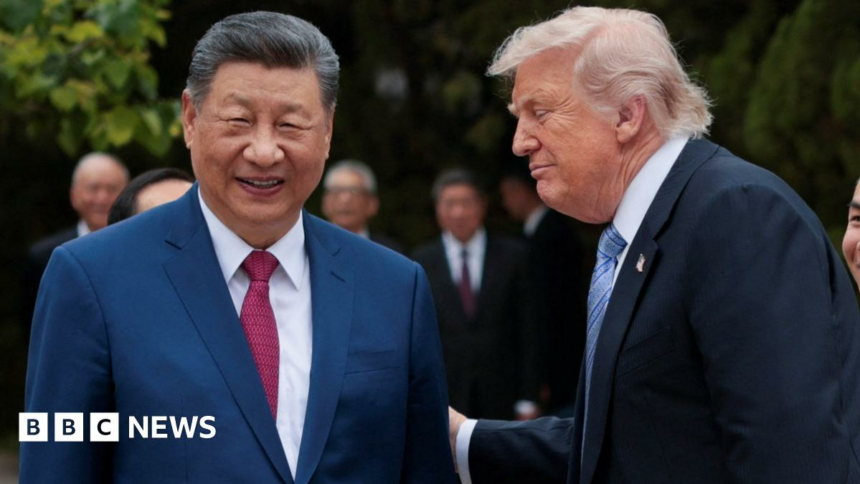
Donald Trump has concluded his final round of talks with Xi Jinping and wrapped up his state visit to Beijing
Trump said the meeting was "very successful, world-renowned, and unforgettable", while Xi called it a "historic and landmark" visit, according to Chinese state media
He may speak to the media on Air Force One soon, potentially revealing details of the talks which have so far remained scarce
Trade, oil, Iran and Taiwan were among the topics discussed over two days of meetings
Earlier Trump said Xi had committed to withholding military equipment from Iran, in an interview with Fox News
The US president also said China wants the Strait of Hormuz open again and that Beijing has agreed to buy oil from the US
We've seen very little policy agreed between the two sides but the real win may be that these talks happened at all, writes our China correspondent
Edited by Gavin Butler, with reporting from Laura Bicker, Stephen McDonell and Tom Bateman in Beijing Suranjana Tewari
Asia Business Correspondent
US trade representative Jamieson Greer has offered one of the clearest glimpses yet into what was discussed during the Trump-Xi summit in Beijing.
Speaking to Bloomberg TV, Greer said it had not yet been decided whether to extend the current US-China trade truce beyond its expiry later this year.
Greer also said rare earth exports from China to the US were improving, although approvals for some shipments remain slow.
The US expects China to buy “double-digit billions” of dollars worth of American farm goods following the summit, he added.
Trump separately told Fox News that “China will buy a lot of our farm products".
Analysts expect soybeans – America’s biggest export to China – to remain central to any agreement.
China, however, did not confirm any agricultural deals.
Asked whether Beijing had agreed to further farm purchases, foreign ministry spokesperson Guo Jiakun said only that both countries had agreed to maintain stable economic and trade relations.
Ian Tang
BBC Monitoring
Chinese state media has been highlighting Xi's role in arresting the deterioration of relations between the US and China.
Xi "has always taken a strategic and long-term perspective" when it comes to relations with Washington and "offered principles" on how the two countries should "find a right way to get along" the reports say.
After Beijing confirmed Trump's visit on 11 May, the Global Times published an editorial on how Xi had held several calls and meetings with Trump in the past year, which helped "correct the course of the bilateral relationship".
Yesterday, the People's Daily ran a commentary by Xie Feng, the Chinese ambassador to the US, who wrote that Xi had "steered the direction" of China-US relations "at crucial moments" and guided bilateral relationship forward over the "storms" over the last nine years – a reference to the ups and downs of ties with Washington since Trump's last visit in 2017.
Such messaging is a deliberate move to portray Xi as an experienced statesman, and to assure the Chinese public that Xi's approach to diplomacy is beneficial for the country. Laura Bicker
China correspondent
Xi seemed to enjoy giving Trump a Chinese history lesson as they toured the 15th Century Temple of Heaven. The US leader revelled in the carefully choreographed stagecraft.
But for a president who built his brand on being tough on China, he seemed rather deferential in his tone and unusually quiet in front of the cameras – especially when asked about Taiwan.
He also hasn’t announced any major trade – something he has been pursuing since he first became US president in 2016.
Xi will view Trump as a leader that has been forced to U-turn on trade tariffs and that is now embroiled in a war in the Middle East that he cannot seem to end.
For the last five years there has been a saying in China – “the east is rising, the west is declining.”
Trump’s volatility and mercurial style has allowed Xi to re-position his country.
China was once eager to catch up to the west – now Xi may feel after playing host to the US president, that he is on the verge of surpassing it.
Canadian Prime Minister Mark Carney with Chinese leader Xi Jinping
Beijing has been busy making trade deals with other countries since the last US-China summit in October.
In January, China and South Korea signed multiple export contracts and agreements for its businesses to cooperate in boosting technology, trade and transportation.
China and Canada – which have been butting heads with Washington over tariffs – agreed to lower duties against each other, marking a breakthrough after years of strained ties.
And in May, China scrapped its tariffs on most African countries, deepening its ties with the continent.
Some analysts say China's deals have portrayed Beijing as a partner for trade, in stark contrast to the sanctions that the US has introduced.
Earlier Trump told Fox News about several trade commitments Xi had apparently made, including the purchase of 200 Boeing jets, US oil and agricultural products such as soybeans.
But at a Chinese foreign ministry press briefing taking place now, its spokesperson appears to be sidestepping questions about those deals.
Without confirming or denying the deals, the spokesperson instead pointed to the "important consensus" that both sides have reached during Trump's visit.
"The essence of China-U.S. economic and trade relations is mutual benefit and win-win cooperation," the spokesperson said in another response.
As analysts size up the achievements of this summit, it's worth looking back on what Trump and Xi agreed on the last time the US president was in Beijing.
Trump's 2017 visit to China was largely seen as a success, with both sides signing trade agreements worth over $250bn across various sectors – allowing Trump to demonstrate his efforts at shrinking the US' trade deficit with China.
Trump said during his visit that he "did not blame China" but instead faulted previous US administrations for “a very unfair and one-sided” trade relationship with China – a departure from his previously intense rhetoric about the issue during his 2016 presidential campaign.
Xi, on his part, said China is willing to "focus on cooperation [with the US]" and managing the two countries' differences.
While the optics were positive, however, some analysts said the meeting did little to improve trade relations in a sustainable way. Some also pointed out that unlike previous US leaders, Trump failed to address allegations of human rights abuses in China, in favour of prioritising trade deals.Laura Bicker
China correspondent
This visit has been heavy on pageantry but so far, we’ve seen very little policy agreed between the two sides.
It does seem that the war in Iran has dominated a summit that was supposed to be about trade.
Trump claims Xi has committed to withholding military equipment from Iran. The Chinese Foreign Ministry has also released a statement which says that Beijing has been working tirelessly to help end the conflict – an acknowledgement that officials are working behind the scenes to nudge China’s ally Iran toward the negotiating table.
Trump also claims that China is in discussions to buy 200 Boeing aircraft and maybe even US oil.
We expect to hear that both sides have also agreed to continue the trade truce agreed in Busan last October.
The real win may be that these talks happened at all.
On this trip Trump brought along with him some of the most senior members of his administration, executives from major US companies – and an unexpected guest.
Brett Ratner, the director of the Rush Hour film franchise, accompanied the US president to Beijing reportedly to scout locations for a fourth movie in the Rush Hour series.
Ratner hinted as much on Instagram yesterday when he posted a video stepping out from the Great Hall of the People. "East Meets West," he said in his caption, alongside the hashtag #RushHour4.
Ratner directed and produced Melania, a documentary about the first lady, that was released earlier this year.
Known for his action movies, the Hollywood director took a career hiatus in 2017 when he was accused by multiple women of sexual misconduct – allegations which he denied.
Brett Ratner, holding his phone up in this photo, was spotted among Trump's delegation in Beijing
Air Force One has now taken off from Beijing, as Trump heads back to Washington after his highly anticipated meetings with Chinese President Xi.
This video can not be played
Trump waves farewell as he leaves China
We now have a Chinese state media readout of the Zhongnanhai talks between Xi and Trump.
Xi called it a "historic and landmark" visit and said that the two leaders established "a new positioning for the constructive strategic and stable relationship" between their two countries.
"President Trump hopes to make America great again, and I am committed to leading the Chinese people to realise the great rejuvenation of the Chinese nation," he said in the remarks, adding that both countries should implement the "important consensus" reached.
Trump said the visit was "very successful, world-renowned, and unforgettable", according to the Chinese readout, and called Xi "an old friend of mine," saying "I have great respect for him".
"I am willing to maintain sincere and in-depth communication with President Xi Jinping and warmly look forward to hosting him in Washington."
At Beijing Capital International Airport, Trump has just walked up the stairs to enter Air Force One.
It's a red carpet sendoff for Trump, who walks past rows of Chinese soldiers standing at attention and students waving Chinese and US flags in unison.
As he said his goodbye to his Chinese hosts, Trump grabbed Chinese foreign minister Wang Yi by the shoulders and gave him a friendly pat.
Trump's motorcade is leaving Zhongnanhai and is bound for the airport, marking an end to the US president's visit to Beijing.
Stay with us as we bring you more updates and analysis from the Trump-Xi meeting.Laura Bicker
China correspondent, reporting from Beijing
Xi Jinping has been rolling out the red carpet for world leaders eager to do a trade deal with China – including key US allies like Britain, Canada and Germany.
The Chinese leader has been eager to portray himself as a stable, global leader in contrast to the unpredictable US president.
"We are witnessing an historical change," says John Delury, a senior fellow from the Asia Society's Center on US-China Relations.
"I hesitate to put too much on this specific summit, but the inexorable rise of China to a place where it is legitimately rivalling the US. That is now happening before our eyes. Beijing is now the second world capital."
China has welcomed a parade of high-profile foreign leaders in recent months including France's Emmanuel Macron, South Korea's Lee Jae Myung, Canada's Mark Carney and Germany's Friedrich Merz.
In January, Keir Starmer became the first British prime minister to visit China in nearly a decade.
US President Donald Trump's sweeping tariffs and unpredictable threats – from acquiring Greenland to pulling troops from Europe – have cast uncertainty over America's longstanding alliances.
This has pushed US allies closer to China, the world's second-largest economy. And Beijing is happy to project an image of stability in contrast to the US.
During Carney's visit to Beijing in January, in which he signed a series of trade deals with China, he told reporters that the global order was at a "point of rupture".
The re-calibration of ties with China has set Canada up "well for the new world order", he said.
Here's another presidential conversation that was heard during Trump and Xi's walk around Zhongnanhai, captured on video:
"Can I ask the President: with other dignitaries from other countries, presidents or prime ministers, does he bring them here?" Trump asked, as he and Xi stood with their translators in a garden.
"Very few," Xi replied. "We usually don’t hold diplomatic events here. Even after we started having some, it’s still extremely rare."
"For example, Putin," Xi added. The Russian president has visited Zhongnanhai several times during previous visits to China."
"Good. I like it," Trump said.
On Thursday, as the two presidents met for bilateral talks, Russia announced that Putin would pay another visit to China very soon.
Stock image of kung pao chicken
Trump and Xi are now having a working lunch. Here's what's on the menu, according to the White House:
Meanwhile, reporters in the White House travelling pool are having McDonald's delivered to their vans.Suranjana Tewari
Asia Business Correspondent
One of the clearest shifts emerging from the Trump-Xi summit is how directly Beijing is now linking Taiwan to the broader economic relationship with the United States.
Over the past year of trade talks, Taiwan was largely treated as one of several areas of friction – particularly around semiconductors, US-Taiwan trade ties and American arms sales to Taipei.
But the messaging from Beijing yesterday suggests that how the US approaches Taiwan is becoming more of a pre-condition to long-term economic stability between the two sides.
According to Chinese state media, Xi Jinping said the US and China had agreed to a “new positioning” for relations built around “constructive strategic stability”.
But he then warned that Taiwan remained the “most important issue” in US-China relations, adding that mishandling it could push ties into a “highly perilous situation”.
Taiwan has always been a red line for Beijing, but it seems to be becoming more of a bargaining tool that could shape trade, technology and relations.
As we mentioned earlier, one of the things to look out for in this final round of talks is whether Xi pressures Trump on the issue of Taiwan.
Yesterday Xi had called Taiwan the "most important issue in China-US relations" and warned of potential "conflict" with the US over the self-ruled island.
He added that Taiwan independence is "fundamentally incompatible" with peace in the Taiwan Strait.
Later on Thursday Taiwan's foreign ministry responded saying that "Beijing is the sole risk to regional peace and stability".
The ministry added that it would continue to cooperate with the US and other countries to ensure regional security and prosperity.
Neither Trump nor the US have said anything publicly during the trip so far about what they have discussed about Taiwan.
Now we bring you more quotes from Trump, from the White House pool of reporters.
During their walk around Zhongnanhai, Trump said at one point that "these are the most beautiful roses anyone has ever seen".
Trump was later heard saying, on his way to the tea room, that Xi would give him roses for the White House Rose Garden.
Trump also mentioned Xi's potential visit to the US on 24 September.
"Like reciprocal trade the visit will be reciprocal," Trump said. "So we’re gonna lay it on the line and we’re gonna have and you’re gonna walk away hopefully very impressed, like I’m very impressed with China."
This video can not be played
Xi and Trump tour Zhongnanhai garden
President Xi has taken President Trump on a tour of Zhongnanhai, the heavily guarded compound where top Chinese leaders live and work. This is the main event of Trump's last day in Beijing, before he's set to fly back to the White House.
Stay with us as we continue to bring you the latest updates on Trump's visit to Beijing.
Copyright © 2026 BBC. The BBC is not responsible for the content of external sites. Read about our approach to external linking.
Trump in China: US president concludes 'very successful' talks with Xi in Beijing – BBC



Leave a Comment

