


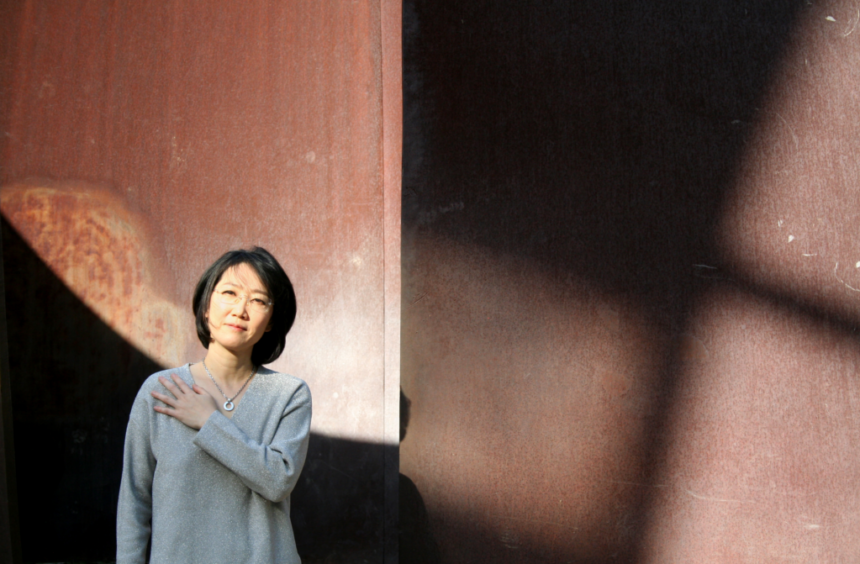
Kay Kyurim Rhie’s compositions are known for their boldness and timbral expressiveness. Her works have been commissioned by leading ensembles, including the Los Angeles Philharmonic. Rhie, associate professor of composition at The UCLA Herb Alpert School of Music, is a 2026 Guggenheim Fellow, a strong recognition of the resonance of her distinct voice.
But composing was not always her plan. As a student, she loved languages and writing, and she spent several years pursuing a career as a journalist. And her path has been as cosmopolitan as her music, whisking her across cultures, across continents. We spoke with Rhie about her journey—and where she is headed next.
# # #
How did you first experience music?
I started playing the piano when I was in first grade.
This was in Korea?
Yes. I was born in South Korea. I played piano and I did a lot of accompanying. I was a church pianist starting around 12 and I played with the choir. But I didn’t come from a musical family. My dad was a writer. So, in my house, the walls were always books. I liked to write. I had a very close relationship to words and languages.
What was it like growing up in Korea?
It was a very turbulent time. My dad had various challenges in the publishing world, and so we knew we were going to have to immigrate at some point. I was only nine years old, and I knew we were eventually going to leave. I remember thinking to myself, “Oh, I’m going to have to learn English at some point.”
That’s a pretty heavy revelation for a nine-year-old.
Yes, but I didn’t really know what it would mean. Looking back, at least it prepared me to brace early on being in between languages and cultures. I liked, or perhaps tried to like, learning English. I recall being amused by forming a kind of a sensorial relationship with languages that were distinct from Korean sounds.
But still, the atmosphere in Korea sounds tense.
Yes – dictators were in power, the student movement was strong. There was often tear gas in the air. There was angst everywhere. Our parents, after all, they were the generation that went through the Korean War. They would tell us stories about how they had to vacate their homes, and move down south, and about the bombs that would go off. But it was also a hopeful time my generation. Still, people were distrustful of the government, which kept the threat of the Korean war—which technically never ended—the politicians used that external threat as a tool and a justification.
And so your family moved.
Yes. I’m 16 and I’m suddenly in Riverside, California. There was a gap of one year when the family simply did not have any bandwidth for my musical training. And I went to two high schools in California during which I found the piano teacher and then went to UCLA to continue studying piano with him.
When did you begin studying music composition?
I took a semester abroad in Korea, where I ended up being close friends with the composition majors at Yonsei University. I might have been one of the few available pianists who had good sight-reading skills because the composers I was hanging out with would say “Can you play my piece on my composition recital?”
I played their pieces, and they were interesting. These were new expressions of music, quite removed from Chopin, Brahms, Rachmaninoff, Beethoven that I used to play. It resonated with me in a different way. I loved that it was not always polite. They were at times explosive, cold and strange as it were describing the discordant reality. It was very freeing to me. So, I started taking some of their composition courses, and I learned serial composition technique, and other things.
So you returned to UCLA and studied composition?
I came back and asked the composition professors—who are still here, and are now my colleagues—I asked them if I could take some of their composition classes. And that was my pivot.
And then you were a composer?
Well, I graduated, and I had to work. I needed money, but I also needed health insurance. So I became a journalist at a Korean language newspaper in LA.
What was your beat?
I applied as a culture writer. But they said “No, no, no, you need to learn the real ropes.” So they sent me to Metro News, and I covered anything and everything under the sun. They sent me to cover fire scenes and crime scenes. And the editor gave me a hard time about it. He would tell me “You don’t know how to write facts.” So I had to learn how to write facts. I learned how to interview. At times I felt like a private investigator, uncovering facts. It was exhilarating in a way.
After about a year and transferring around quite a bit, I finally landed in my dream position as a culture writer. I attended all the concerts, exhibitions, operas and ballets that I wanted to. It was great, but it made me miss making music.
You ended up coming back to UCLA for a master’s in composition at this time. But you chose to continue your studies at Cornell. What led to that decision?
Well, two things. I wanted to apply for the doctoral program in composition at UCLA, but the composition professors told me “you have to get out. You need to learn new stuff, different things.” And that made sense to me. But also, I wrote a trio called “Transits to Paradise” that won the grand prize at the Ojai Music Festival, and the judge of that composition was Steven Stucky, and he taught at Cornell. And a lot of people urged me to go study with Steven Stucky and in the East Coast.
What impact did Stucky have on your music?
He was a great teacher as well as a scholar. He wrote a very famous book on Lutoslawski, and you wouldn’t believe how many composers I’ve met over the years who’ve told me “That book basically told me how to compose.” Lutoslawski was post-tonal—meaning, he composed outside of that tonal language that we often identify as classical music. But he thought of harmony very different than Arnold Schoenberg did. It was much more color-based, and the way he thought of 12 tones was not serial. It all had to do with vertical sonorities. You will hear this structure in my music.
But another thing I liked about Stucky was how broad-minded he was. He understood the musical scene on a global scale because he was the new music advisor to the LA Philharmonic for such a long time, working with Esa-Pekka Salonen. Stucky curated the Green Umbrella concerts, and he and Salonen were such good friends.
The Green Umbrella concerts were a real force for new music at that time.
Yes. At one point—and I was still working as a journalist at the Korean newspaper at this time—Unsuk Chin had her first US debut with the Green Umbrella with Esa-Pekka Salonen conducting, because Stucky liked her music, I believe. And it sparked a fire in me.
You covered the concert, as a journalist?
Yes. I listened to the U.S. premiere of her “Acrostic Wordplay,” which was her career breakthrough piece. I heard that piece at the Green Umbrella Concert with Esa-Pekka Salonen conducting. I remember thinking “what is this music?” It was fun, puzzling, intriguing, mysterious, grotesque, and smart – it left a very big impression on me.
What about her music grabbed you?
It was rigorous but mysterious. Heft and humor were both present. And there were these strange, experimental uses of the instruments. She was pushing the envelope of their timbral possibilities. But the musical gestures always felt logical in the similar way that Beethoven is satisfying. So, at the time, it was very unfamiliar, but attractive.
What is your process for writing music?
Well, it is always a learning process. When I first started writing music, I didn’t have the tools to do what I wanted to do. And, funny enough, Lutoslawski said something like, “I couldn’t write the music I wanted to, so I wrote what I could.” So that gave me a great sense of relief. That is exactly how I felt for a very long time. Even now, with each piece, I have a particular set of goals that I want to accomplish, issues that I’ve always wanted to solve. And sometimes I succeed and sometimes I don’t, but little by little I’m inching in closer to where I want to end up as a composer.
Not to be presumptuous, but it doesn’t sound like that is a journey that will ever end.
Probably not!
But it sounds to me like you are looking for new expressions, new languages, each time you compose.
Yes, I think that’s right. There are so many wonderful instruments that are capable of so much. The possibilities open up and it is really exciting—and then you think about two instruments, three instruments, and an orchestra. The possibilities are great. I write very slowly because I try to study all of these possibilities. And there are some failed experiments. The sound has to be right. And then there are other issues like form and procedure, extra-musical expressions that often become my secret program notes.
But as an immediate qualifier, you might say that I’m a timbralist – that I really start from what new things can be done. Instruments and how they are played all have distinct sonic envelopes, how it rises and decays, and how it holds and how it cuts off, and how it attacks. That energy is very different from one instrument to another. And from those gestures and interplay of envelopes, I start to form a structure.
I’m detecting a pattern here—as a child, you loved the sound of languages, and you recognized the different sounds in a different language. You seem to view composition in the same way.
I’m seeing now that much of my past is tied up in my music. I’ve always been fascinated by words, both the syntactical and sonic properties. And that includes sung voices. Also, recently, I’ve been coming to a closer relationship with my heritage. When I came to the United States, I had to learn a new culture, and it took me a while to look back.
The LA Philharmonic’s commission of H’on (2025) took me on a journey exploring the folk music from Korea. So, in the piece there were these gestures and elements of different musical genres from Korea that I wove into the Western orchestral sound.
What piece are you working on right now?
Immediately, I’m finishing a duo for clarinet and vibraphone, a commission by two great musicians based in Texas.
I am also conceiving a triptych, a cycle for a large ensemble. The first piece in the triptych was commissioned by the Chicago Center for Contemporary Composition, for the Grossman Ensemble. The title is Goong-ja Song, and it’s very rowdy. I took as source material pansori, an operatic genre from Korea. Pansori is a one-person opera accompanied only by a single drummer. The singer tells a long story with these extremely virtuosic arias, with huge crazy vibratos and dramatized emotions.
That piece has been completed?
The Grossman Ensemble premiered it last December. The entire triptych, I’m aiming to have that completed by 2028. The next two movements, which I’m thinking about, will take inspiration from different vocal expressions. For the third movement of the entire cycle to be titled “Meditation on Voice” will be ethereal and calming.
Wait—what about the second movement?
I’m still thinking about it. And I’m very excited.
445 Charles E. Young Dr East
2520 Schoenberg Music Building
Los Angeles, CA 90095