


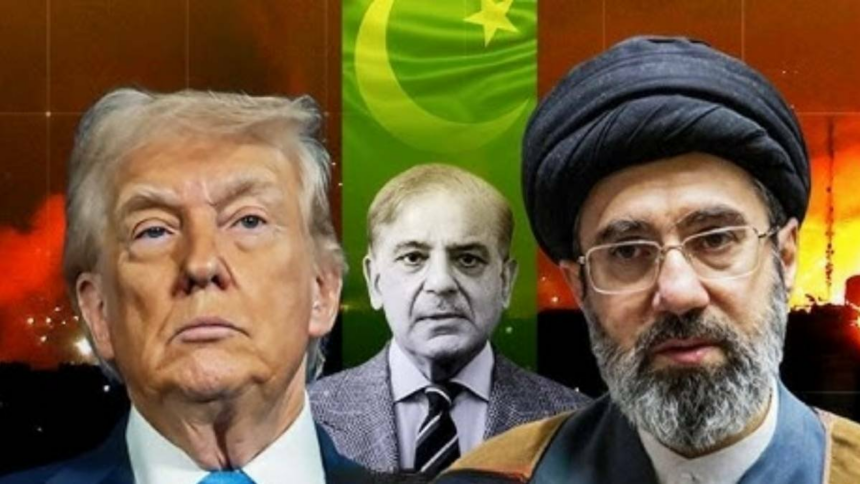
In the midst of heightened conflict between the US and Iran, global leaders have acknowledged and appreciated Pakistan’s role as a mediator in the Middle East conflict.
Countries such as China and Kuwait explicitly appreciated Pakistan’s efforts. At the same time, regional partners, including Turkey, Saudi Arabia, and Egypt, supported its diplomatic initiatives, and both Iran and the United States endorsed Pakistan’s role by engaging with it as a facilitator.
Pakistan is trying to de-escalate tension between the United States and Iran. Washington and Tehran agreed to a ceasefire following the sustained diplomatic engagement of the Pakistani leadership. The first session of the peace talks has been held in Islamabad. Although both sides maintain their positions, Pakistan’s full-fledged efforts continue in the hope of securing diplomatic breakthroughs.
In the realm of global politics, image-building is essential for securing and advancing state interests. Perception often brings more benefits than facts alone and plays the most significant role in foreign policy and diplomacy. Based on these, states attract investors to strengthen their economy.
It also opens doors for bilateral trade opportunities and political advantages. In today’s world, countries are evaluated based on their leadership qualities, political values, and democratic systems.
Read More: Pakistan’s Resolute Defense and Diplomatic Poise: A Testament to National Strength
Historically, Pakistan’s prolonged engagement as a frontline state against terrorism, particularly the global war on terror, has significantly affected its international image. Security-related narratives and media framing have contributed to the formation of negative international images of countries.
The global surveys and opinion polls often portray Pakistan unfavorably, largely associating it with terrorism and instability.
At the same time, bad governance, corruption and political instability reinforce negative perception, as reflected in global indicators; for instance, the Transparency International Report indicates that Pakistan’s score of 28 out of 100 on the corruption index reflects a low level of perceived public sector transparency.
In the subsequent years, improved security conditions and a surge in foreign tourist arrivals contributed to a positive perception, while economic and governance challenges have persisted.
The current diplomatic efforts have opened new avenues. In international relations, states enhance their soft power when their foreign policies are perceived as legitimate and morally credible. In this context, Pakistan’s constructive role in navigating the US-Iran conflict paved the way for reshaping the world’s perception and the potential economic opportunities.
Pakistan’s emerging role reflects a broader shift in its foreign policy. This change is not accidental, but a result of changing regional conditions, economic demands, and the growing importance of middle powers in resolving conflicts.
Countries like Qatar and Norway successfully leveraged mediation to enhance their global influence, even though they have no massive military capability or leading economies.
At the same time, Pakistan has a strong military capability, an ideal location, and a prominent position in the Muslim world. It could become a more exceptional player in world politics and the diplomatic stage.
Read More: Pakistan Optimistic About US-Iran Agreement: FO
In the age of the digital arena, Media platforms highly influence public perceptions in international conflicts. Media coverage works as narrative building and information dissemination. When a state representative and the media outlets highlight and applaud the positive role of any state, their reach extends to the general public. As the Iranian public was seen praising Pakistan.
Similarly, an Ipsos survey suggested that during the US-Iran conflict, early diplomatic efforts of Pakistan were viewed skeptically at the international level, with nearly 90% negative perception. On March 23, when Pakistan engaged both with Iran and US officials, it faced criticism over its internal instability, tensions with Afghanistan, and doubts about its neutrality, especially because some saw it as close to US interests.
However, global perception sharply shifted to 70% positive by April 8 following the announcement of a temporary ceasefire.
These developments highlight Pakistan’s growing diplomatic and strategic leverage as a valuable tool to resolve severe economic problems and financial crises. The Pakistani leadership needs to balance internal governance with external diplomatic engagements effectively.
It is important to avoid the past security-centric approach to the current non-alignment peace-making strategy, which could become its greatest strength rather than a challenge.
Accordingly, if a positive global image is sustained through consistent diplomacy, it can significantly enhance Pakistan’s strategic and economic prospects in the long term.
*The views presented in this article are the authors’ own and do not necessarily reflect the views of The Diplomatic Insight.
Saqib Tariq is a student of Conflict, Peace, and Development Studies at COMSATS University Islamabad, Abbottabad, and affiliated with the Institute of Regional Studies, Islamabad.
About Us
Our Story
Leadership
Meet our Team
Advisory Board
Meet Our Partners
Career
Engage
Write for us
Monthly Magazine
DiploStore
DiploTV
Subscription Plans
TDI + IPDS Internship
Our Services
Advertise with us
Diplomatic Consultation
Media Monitoring Services
Media Partnership for Events
Content Partnership
TDI Partnerships Portfolio
Newsletter
Regions
Africa
Europe
South Asia
Central Asia
North America
Middle East
China
South America
East Asia
Eurasia
Oceania/Pacific
Southeast Asia
Read
News Analysis
OpEd
Women Insight Daily
Blog
In Pictures
Situationer
Explainer
Explore
Sitemap
Business
Culture
Education Diplomacy
Environment & Climate
Health Diplomacy
Contact us
Email: info@thediplomaticinsight.com
Whatsapp: +923073555442
Follow us
About Us
Our Story
Meet our Team
Advisory Board
Meet Our Partners
Engage
Write for us
Monthly Magazine
DiploStore
DiploTV
Subscription Plans
TDI + IPDS Internship
Our Services
Advertise with us
Diplomatic Consultation
Media Monitoring Services
Media Partnership for Events
Content Partnership
TDI Partnerships Portfolio
Regions
Africa
Europe
South Asia
Central Asia
North America
Middle East
China
South America
East Asia
Eurasia
Oceania/Pacific
Southeast Asia
Read
News Analysis
OpEd
Women Insight Daily
Blog
In Pictures
Situationer
Explainer
Explore
Sitemap
Business
Culture
Education Diplomacy
Environment & Climate
Health Diplomacy
Contact us
Email: info@thediplomaticinsight.com
Whatsapp: +923073555442
Newsletter
Follow us
The Diplomatic Insight is an entity Diplomatic Insight Publishers Pvt Limited. Part of Diplomatic Insight Group. 2026 All Rights Reserved.
Diplomatic Insight Group head office, 2nd Floor, Mehria Plaza, Block D, G-6/2, Islamabad
Copyright © 2026 Diplomatic Insight Publishers
Bridging Conflict: Pakistan’s Soft Power in the US-Iran Standoff – The Diplomatic Insight



Leave a Comment