


Forests across Nepal are now resonating with the melodic calls and constant chatter of summer migratory birds as spring reaches its peak in the country. Their sounds echo through woodlands, grasslands and farmlands, drawing visitors and signalling seasonal ecological activity. While some birds are nesting, others are busy feeding and raising their chicks.
Most of the birds currently found in Nepal’s forests and grasslands have travelled hundreds or even thousands of miles in search of favourable habitats. But experts warn that shrinking habitats, encroachment on wetlands, increasing use of chemical fertilisers and widespread forest fires are making survival increasingly difficult for migratory birds in Nepal.
These pressures are affecting their feeding patterns, breeding cycles and overall survival. Bird migration patterns in Nepal are also becoming increasingly disrupted.
To raise awareness about the conservation of migratory birds, World Migratory Bird Day is observed twice a year internationally, on the second Saturdays of May and October. This year, it falls on May 9. Conservationists say the campaign helps highlight the positive role migratory birds play in ecosystems while drawing attention to the growing threats they face.
Senior ornithologist Hem Sagar Baral said climate change is already affecting Nepal’s reputation as one of the world’s premier destinations for birdwatching tourism.
“Birds that once travelled to one location for feeding and breeding are now reaching entirely different areas,” Baral said. “When they move into unfamiliar habitats, the challenges increase. Some migratory species are beginning to behave like resident birds.”
According to him, changing climate conditions are also reducing food availability for chicks, making it harder for birds to raise their young successfully. “This could eventually affect Nepal’s bird tourism sector as well,” he said.
Polluted rivers and lakes, the use of pesticides in water sources, environmental degradation and illegal poaching are also making life difficult for migratory birds.
Ornithologist Krishna Prasad Bhusal said the World Migratory Bird Day aims to strengthen global cooperation for the sustainable conservation of migratory species and the protection of their feeding grounds, habitats and flyways.
“The campaign has created some awareness, but it needs to become more effective,” Bhusal said.
Nepal receives migratory birds twice a year. During winter, wetlands become crowded with ducks and other waterfowl escaping colder regions. As temperatures rise, these birds return to their breeding grounds, while summer migratory birds arrive in forests, shrublands, grasslands and agricultural fields.
Birds migrate annually between breeding and feeding grounds according to seasonal changes. They travel from one place to another, from one country to another and sometimes even between continents in search of suitable weather, safe habitats, food and breeding conditions.
More than 150 species of winter migratory birds, including ruddy shelducks, bar-headed geese, comb duck, gadwall, falcated duck, Eurasian wigeon, spot-billed duck, and pochards, arrive in Nepal from Russia, China, Mongolia, Kyrgyzstan, Korea, Tibet and parts of Europe to escape the harsh winter.
Similarly, over 62 species of summer migratory birds, including Asian paradise flycatchers, black-naped monarch, blue-tailed bee-eaters, chestnut-headed bee-eaters, Jacobin cuckoo, scarlet minivet, and oriental dollarbird arrive from India, Sri Lanka and Southeast Asian countries such as Thailand, Myanmar, Malaysia and Indonesia during spring.
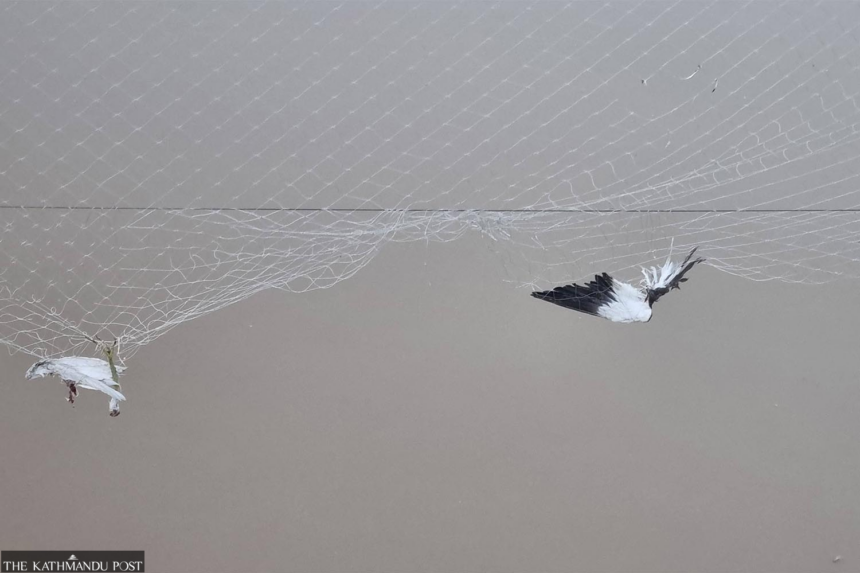
According to conservationists, migratory birds face serious dangers during their journeys. Many die after colliding with exposed power lines, while others struggle with obstacles along migration routes or fail to reach their destinations because climate change disrupts their navigation systems.
Ghana Shyam Gurung, Country Representative of WWF Nepal, said climate change is creating food shortages for chicks and altering breeding seasons. “When breeding timings shift, birds face additional stress,” he said.
Of the world’s more than 11,000 bird species, nearly 40 percent migrate regularly according to seasonal cycles. Scientists believe migratory birds navigate using the positions of the sun and stars, as well as rivers, mountain ranges and the earth’s magnetic field. Genetic traits linked to migration are also believed to pass from one generation to the next.
The routes used during migration are known as flyways. Nine major flyways have been identified globally, and Nepal lies along the Central Asian Flyway. Interestingly, birds tend to follow the same migration corridors year after year.
Experts say the number of migratory birds arriving in Nepal has been declining. Although summer migratory birds are not systematically counted, winter waterbird populations have shown a downward trend.
Laxman Prasad Poudyal, executive director of Bird Conservation Nepal and coordinator of the national count of water birds, said 99,565 water birds from 94 species were recorded in 2025, compared to 90,688 birds from 89 species in 2026.
The census covered 18 major wetlands and 78 smaller wetlands, rivers, streams and ponds across Nepal.
Key habitats for migratory waterbirds, including Jagadishpur reservoir, Koshi Tappu Wildlife Reserve, Barju Lake, and Chitwan, Banke and Bardiya national parks and the surrounding areas, have all reported declining bird populations.
Ornithologist DB Chaudhary said Nepal remains attractive for summer migratory birds because longer daylight hours allow them more time to search for food.
“They can raise chicks in relatively safe habitats with less competition for food,” Chaudhary said. “That is why many species are drawn here.”
However, he warned that habitat destruction, forest encroachment and pollution are continually making survival more difficult.
The journeys undertaken by migratory birds are often extraordinary. Bhusal said the Arctic tern, a bird roughly the size of a pigeon, makes the longest migration of any known animal, travelling around 90,000 kilometres annually between the Arctic and Antarctic.
He added that the great snipe can fly continuously at speeds of up to 97 kilometres per hour over distances of nearly 6,800 kilometres.
The bar-tailed godwit, meanwhile, can fly for around 10 days without food or rest while covering nearly 13,000 kilometres from Alaska to New Zealand.
Researchers have also recorded bar-headed geese flying over the Himalayas at altitudes of 9,375 metres, higher than the summit of Mount Everest, to spend winter in Nepal.
At such extreme altitudes, oxygen levels and temperatures are exceptionally low, making flight extremely difficult for most animals.
“How these geese manage such flights still amazes researchers,” said Rajendra Suwal of WWF Nepal.
He said many winter migratory birds enter Nepal through mountain passes in the Himalayas. Summer migratory birds also travel thousands of kilometres to reach Nepal. The Jacobin cuckoo, for example, arrives from Africa by riding pre-monsoon winds over a journey of nearly 5,000 kilometres.
Recent studies have also shown that the common swift, another migratory species seen in Nepal during summer, can fly in the air continuously for up to 10 months.
Birds are considered among the species most closely connected to human life and ecological balance. They play important roles in pollination and pest control by feeding on insects and rodents harmful to crops.
They also disperse seeds across landscapes, helping forests and vegetation regenerate. Conservationists say they are essential for maintaining ecological balance and natural beauty.
Bhagawan Raj Dahal, Country Representative of the Zoological Society of London Nepal, said birds are invaluable allies for farmers and ecosystems alike.
Nepal, regarded as an important destination for bird tourism, has recorded 903 bird species so far.
Paudel is pursuing a Master’s degree in Environmental Science and Sustainable Agriculture at Kentucky State University.
Climate change poses growing threats to migratory birds in Nepal – The Kathmandu Post



Leave a Comment