4 min read
Francis Reddy
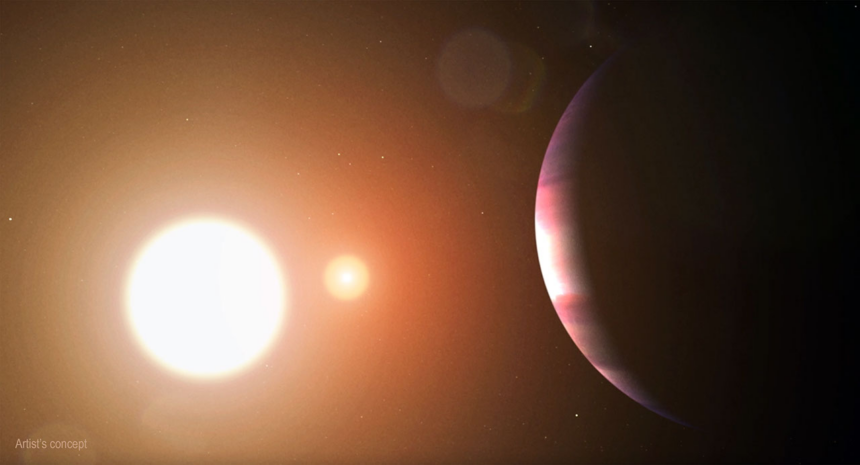
A study of NASA’s TESS (Transiting Exoplanet Survey Satellite) data on stellar pairs undergoing mutual eclipses has uncovered more than two dozen candidate exoplanets, or worlds beyond our solar system. This method allows the mission to locate planets it couldn’t otherwise detect.
To date, TESS has discovered 885 confirmed exoplanets and identified more than 7,900 candidates, nearly all found because the planets pass in front of their stars from our perspective. These events, called transits, produce a small, regular dip in the brightness of the planet’s host star. TESS also observes tens of thousands of eclipsing binary stars — two orbiting stars that alternately eclipse each other from our vantage point. Astronomers can detect the gravitational tug of exoplanets in these systems by carefully measuring the exact timing of many eclipses. Prior to the new study, discoveries by NASA’s retired Kepler mission and other facilities had recorded 16 transiting worlds around binary stars, while TESS had found an additional two.
“Identifying transits in binary systems clearly is challenging, but we’d like to know more about the range of planets that can form around two gravitationally bound stars,” said study lead Margo Thornton, a doctoral candidate at UNSW (University of New South Wales) in Sydney. “So we developed a survey to search for planets using stellar eclipses that is not limited to the orientation of the planet’s orbit.”
A paper describing the findings published May 4 in the journal Monthly Notices of the Royal Astronomical Society.
For planets located in binary systems, the orientation of the planet’s orbit can tell us about how that system formed. Some models of planet formation in binary systems suggest planets mainly form near the plane formed by the two orbiting stars, increasing the likelihood of binaries hosting transiting worlds. But other models indicate a much more disorderly formation process, with the stellar pair stirring its young planets into wider and more tilted paths much less likely to undergo transits.
The timing of stellar eclipses can gradually change through tidal and rotational interactions between the stars, the effects of general relativity, and the presence of other unseen masses, such as planets, in the system. All of these forces cause the entire orbital plane of the binary to rotate, or precess, and this in turn alters the eclipse timing.
“The key to calculating all of these different influences is the long, rich set of observations available from TESS,” said co-author Benjamin Montet, a Scientia associate professor at UNSW Sydney. “After analyzing 1,590 binaries with at least two years of TESS data, we found 27 with candidate planets that now await confirmation.”
Since science operations began in 2018, TESS has tiled the sky by observing large swaths, called sectors, for nearly a month. Currently, the mission’s cameras capture a single image of the entire sector, measuring 24 by 96 degrees, about every 3 minutes, with even faster observations of selected targets.
The masses of the new candidates remain uncertain, but the team estimates the smallest world may hold as little 12 Earth masses, with the largest topping out around 3,200 Earths, or about 10 times Jupiter’s mass. Confirming these planets will require future ground-based observations that precisely measure the velocities of the host stars, which will reveal the slight gravitational tugs of any possible planets.
“The TESS mission was built to find transiting planets, and it’s great to see how the same measurements are driving discoveries far beyond its original mission,” said Allison Youngblood, the TESS project scientist at NASA’s Goddard Space Flight Center in Greenbelt, Maryland. “The mission’s continuing data collection is a treasure trove that enables new findings across a wide range of astronomical topics, from asteroids in the solar system to active galaxies powered by black holes in the distant universe.”
You could discover the next exoplanet! Join the Planet Hunters TESS citizen science project, and you’ll learn how to read light curves — plots of light data from distant stars — to find telltale signals from orbiting exoplanets.
By Francis Reddy
NASA’s Goddard Space Flight Center, Greenbelt, Md.
Media Contact:
Claire Andreoli
301-286-1940
claire.andreoli@nasa.gov
NASA’s Goddard Space Flight Center, Greenbelt, Md.
UNSW Sydney: New Star Wars-like planet candidates with two suns discovered
NASA explores the unknown in air and space, innovates for the benefit of humanity, and inspires the world through discovery.