


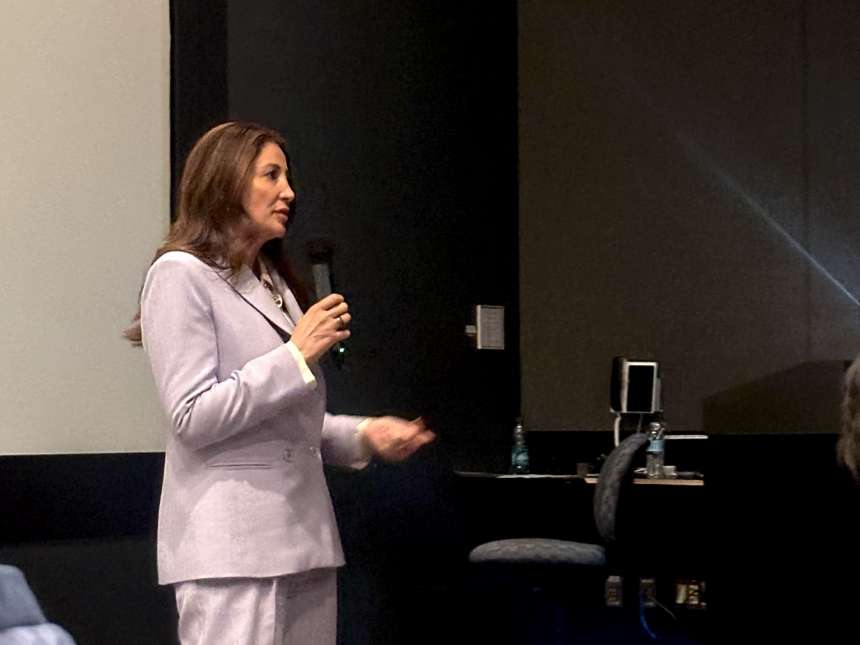
Colgate University’s Lampert Institute for Civic and Global Affairs, in partnership with Colgate’s 13 Days of Green leading up to Earth Day, welcomed former United States Homeland Security Advisor Julia Nesheiwat for her lecture and discussion, “Energy, the Environment and National Security,” on Monday, April 20.
Nesheiwat, a former U.S. Army combat veteran and diplomat with over 20 years in government service, is an expert on the intersection of international energy diplomacy, critical infrastructure protection, defense, environmental science and national security, having served in the Bush, Obama and Trump administrations. She served as homeland security advisor in the first Trump administration from 2020 to 2021.
“I’ve worn many hats in my government career — military, energy, hostage affairs, the Arctic — it was certainly not a planned equation of any means,” Nesheiwat said.
Nesheiwat began by explaining the intertwined nature of energy, the environment and national security
“You can’t meaningfully protect the environment without reliable, affordable energy. You can’t achieve real national security if you’re overly dependent on adversaries for fuel,” Nesheiwat said. “You can’t do either without pragmatic, all-of-the-above policies that actually deliver results rather than just good intentions.”
As a military intelligence officer, Nesheiwat served consecutive tours in Afghanistan and Iraq after 9/11, earning the Bronze Star Medal. She attributes the inspiration for her current work, which links energy and the environment to national security, to an epiphany she had while serving as a young intelligence officer in the field in Iraq.
“Being out there in some of the towns and cities where the bombings were taking place on the critical infrastructure, the oil, gas pipelines, the power plants, the water infrastructure … I just had this thought,” Nesheiwat said. “Yes, we’re focused on counterterrorism issues, but how can we really win the hearts and minds of people who don’t even have the basic access to clean energy, to water, to power, electricity?”
Nesheiwat also discussed the importance of preventing adversaries from using fuel as a geopolitical weapon in the context of current events in the Russo-Ukrainian War and concerning the Strait of Hormuz in Iran. She said that the U.S. recently earned the status as a net exporter of energy, which has allowed for its growing energy independence from adversaries.
Nesheiwat added that the U.S. has also made meaningful progress toward sustainable energy development.
“With regard to the environment, I believe that we absolutely do have a serious responsibility to be good stewards of the air, land and water for future generations,” Nesheiwat said. “The data show real, measurable progress — just the latest numbers, the U.S. power sector emissions have fallen more than 40% since 2005, and overall energy-related CO2 emissions are down about 20% over that same period, even as our economy and population have grown.”
Associate Professor of Economics and Environmental Studies Isla Globus-Harris found Nesheiwat’s outlook on current U.S. energy and environmental affairs intriguing.
“It was an interesting opportunity to hear a different perspective on the current administration’s energy policy priorities,” Globus-Harris said.
Nesheiwat challenged the audience to demand evidence-based policy.
“It’s easy to turn on the TV and look at what social media has and some of the rhetoric that’s out there in the noise, but we really need to ask the tough questions about costs, about timelines, about reliability, unintended consequences and who actually bears the burden,” Nesheiwat said.
The lecture was followed by a Q&A session from attendees, who questioned Nesheiwat on a broad range of topics, including the current administration’s perspectives on various forms of energy, current events in the context of the environment and national security, artificial intelligence (AI) data centers and policy and how to be well-informed in a world of constant political rhetoric and polarization.
“I was especially impressed by the excellent questions Colgate students asked,” Globus-Harris said.
Nesheiwat echoed Globus-Harris’ comments about student engagement by pointing out that the policy world has been affected by a similar enthusiasm for the subject.
“It’s actually a very exciting time in the policy world. I think there’s also a deep appreciation for how interconnected these issues are, the conviction that the United States’ energy future can be secure, it can be prosperous, and of course, environmentally responsible, if we commit to a true, all-of-the-above strategy,” Nesheiwat said.
Sophomore Eloise Jenkins valued Nesheiwat’s expertise in the intersection of these seemingly separate subjects.
“As someone who’s not well-versed in politics, I really enjoyed hearing about what goes into working in different sectors of the government,” Jenkins said. “I appreciated learning about the overlap between energy and national security as those are areas that I didn’t realize were connected.”
The Oldest College Weekly in America. Founded 1868.
Your email address will not be published.
Lampert Institute Hosts Former Homeland Security Advisor for 13 Days of Green Lecture – The Colgate Maroon-News


Leave a Comment