


Notifications can be managed in browser preferences.
Please refresh the page or navigate to another page on the site to be automatically logged inPlease refresh your browser to be logged in
Swipe for next article
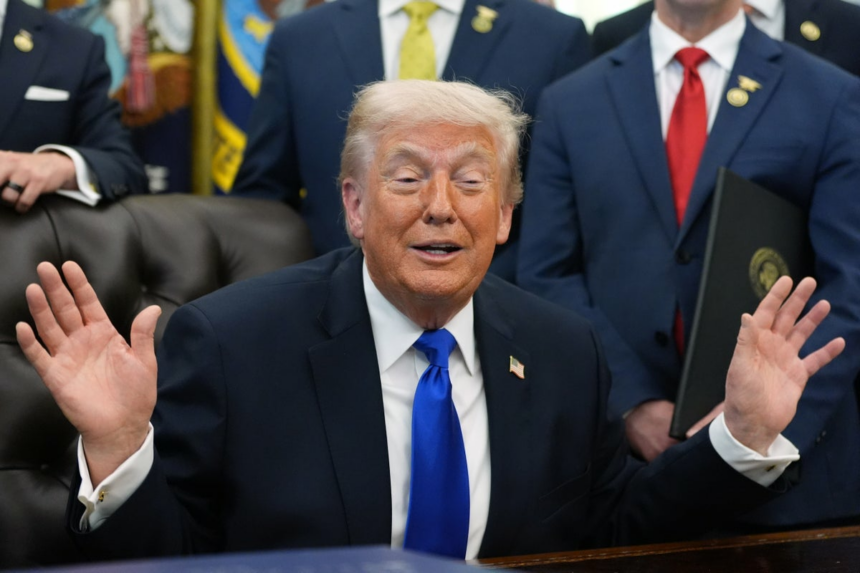
President says US has ‘already won’ the war but he wants to win by a ‘bigger margin’
Removed from bookmarks
I would like to be emailed about offers, events and updates from The Independent. Read our Privacy notice
Donald Trump reportedly received a high-level briefing on Thursday from Centcom commander Admiral Brad Cooper and Chairman of the Joint Chiefs of Staff General Dan Caine on new military options against Iran.
Plans under discussion include a “short and powerful” wave of strikes on Iranian infrastructure, a possible operation to take control of parts of the Strait of Hormuz to restore shipping, and even a special forces mission to secure Iran’s enriched uranium stockpile, Axios reported.
Earlier, Trump said the US had “already won” the war in Iran even as he continued to pressure Tehran to make a deal.
During an interview with Newsmax’s Greta Van Susteren, the president declared that the US had achieved victory, but said he wanted to win by a “bigger margin”.
“We’ve already won, but I want to win by a bigger margin,” he said. “But we have. We have destroyed their navy, destroyed their air force, destroyed all of their — if you look at their anti-aircraft equipment, their radar equipment, their leadership, their leadership is destroyed.”
Despite his insistence that Iran is already beaten, the president is continuing his blockade of the Strait of Hormuz.
The fragile ceasefire agreement between Iran and the United States has already “terminated” hostilities between the two sides, a senior Trump administration said on Thursday, ahead of today’s deadline to end the war or make the case to Congress for extending it.
“For War Powers Resolution purposes, the hostilities that began on Saturday, February 28, have terminated,” said the official, describing the administration’s thinking.
There has been no exchange of fire between the US armed forces and Iran since a fragile ceasefire began more than three weeks ago, the official added.
Earlier, analysts and congressional aides had said they expected Trump to notify Congress that he planned a 30-day extension or to disregard the deadline, with the administration arguing the ceasefire marked an end to the conflict.
The 1973 law allows the president 60 days to wage military action before ending it, seeking authorisation from Congress or asking for a 30-day extension on grounds of “unavoidable military necessity” for the safety of the armed forces.
Defense Secretary Pete Hegseth faced intense scrutiny from furious Democrats on Wednesday during his first congressional appearance since the Trump administration initiated military action against Iran.
Lawmakers grilled Hegseth over the costly conflict, which has proceeded without congressional approval and has already amounted to $25 billion, according to Pentagon figures presented to the House Armed Services Committee.
The contentious hearing, ostensibly focused on the administration’s proposed 2027 military budget of a historic $1.5 trillion, saw Republicans largely supporting the Iran operation and focusing on financial details.
The elite Islamic Revolutionary Guard Corps (IRGC) were set up shortly after the 1979 revolution to protect the clerical ruling system.
The IRGC answers to the supreme leader of Iran. Its mandate to protect revolutionary values has prompted it to speak out against the government when it felt the system was threatened.
It also provides a counterweight to Iran’s professional army.
Before the war, the IRGC had an estimated 125,000-strong military with army, navy and air units. It also commands the Basij religious militia – a volunteer paramilitary force loyal to the clerical establishment that is often used to crack down on anti-government protests. And it oversees Iran’s ballistic missile programme – an issue in Washington’s sights.
The IRGC, branded a terrorist group by the United States, has sought for years to shape the Middle East, according to Iran’s interests.
Its Quds Force influences allied militias across the Middle East, handling relations with Hamas, Hezbollah and the Houthis, among others.
Skirting around the vast oil tankers anchored patiently in the Strait of Hormuz, Iran’s “mosquito fleet” is locking down the critical waterway that is stuck under a double blockade.
The swarm of speedboats, seen as Tehran’s second navy, is now a serious concern for vessels seeking transit through the waterway, especially as these vessels are difficult to track and often carry weapons on board.
Here’s how Iran’s ‘mosquito fleet’ is causing havoc in the Strait of Hormuz:
Watching Hegseth try and answer these probing questions from restrained experts was like watching Buzz Lightyear realize he isn’t really a spaceman, writes Holly Baxter:
The United States and Iran have been held in a stalemate since Donald Trump said he would indefinitely extend an existing ceasefire agreement last month.
While the daily missile strikes have stopped, both sides maintain naval blockades around the Strait of Hormuz, aiming to squeeze the other’s economy for leverage in peace talks.
But talks to end the war have not happened since mid-April, and both sides remain at odds over key issues. Iran says the US must retract its blockade on Iranian trade for talks to restart, while the US says Iran cannot blockade international shipping.
This week, it emerged Iran was asking to decouple the contentious issue of its nuclear programme from talks to end the war and reopen the Strait of Hormuz. The nuclear issue was cited among the reasons for starting the conflict, and Donald Trump publicly remains unmoved.
Now, attention has turned to reports the US is weighing a change in tactic, reopening the hot conflict with Iran to force its hand. Iran threatened yesterday that it would respond with “long and painful strikes” if the US does attack.
The CEO of the world’s largest fertiliser company Yara International has warned that the US-Israel war on Iran could drive up fertiliser prices and disrupt supplies, risking food shortages in parts of Africa.
With key inputs like urea and ammonia already becoming scarce and more expensive due to supply chain disruptions, especially from the Middle East, there are fears of a “global auction” where richer countries secure supplies while poorer nations are priced out.
“The most important thing we can do now is raise the alarm on what we are seeing right now – that there is a risk of a global auction on fertiliser that means it becomes unaffordable for those most vulnerable,” he said.
“Africa is actually quite well positioned to be a major food producer, not only for self-sufficiency, but even for exports to the rest of the world, but the reality is that they are massive food importers.
“But we need to be aware in this part of the world of the potential consequences that if we get to a global auction on food, there will not be a famine in Europe – but we need to be aware of who we are taking the food away from.”
Although shortages are not yet certain, experts say the situation could worsen quickly, particularly for African countries that rely heavily on imports and lack subsidies or strong reserves, leaving their farmers and food systems especially vulnerable.
Join thought-provoking conversations, follow other Independent readers and see their replies
Please refresh the page or navigate to another page on the site to be automatically logged inPlease refresh your browser to be logged in
Iran-US war latest: Trump ‘briefed on final blow’ strike options as he pushes Tehran to make deal – The Independent


Leave a Comment