


Sign up for the wires and see archived wires
Browse experts available to comment on breaking news
Request an expert contact, get responses directly to your inbox
Find an expert by topic in a comprehensive database
The neural tube
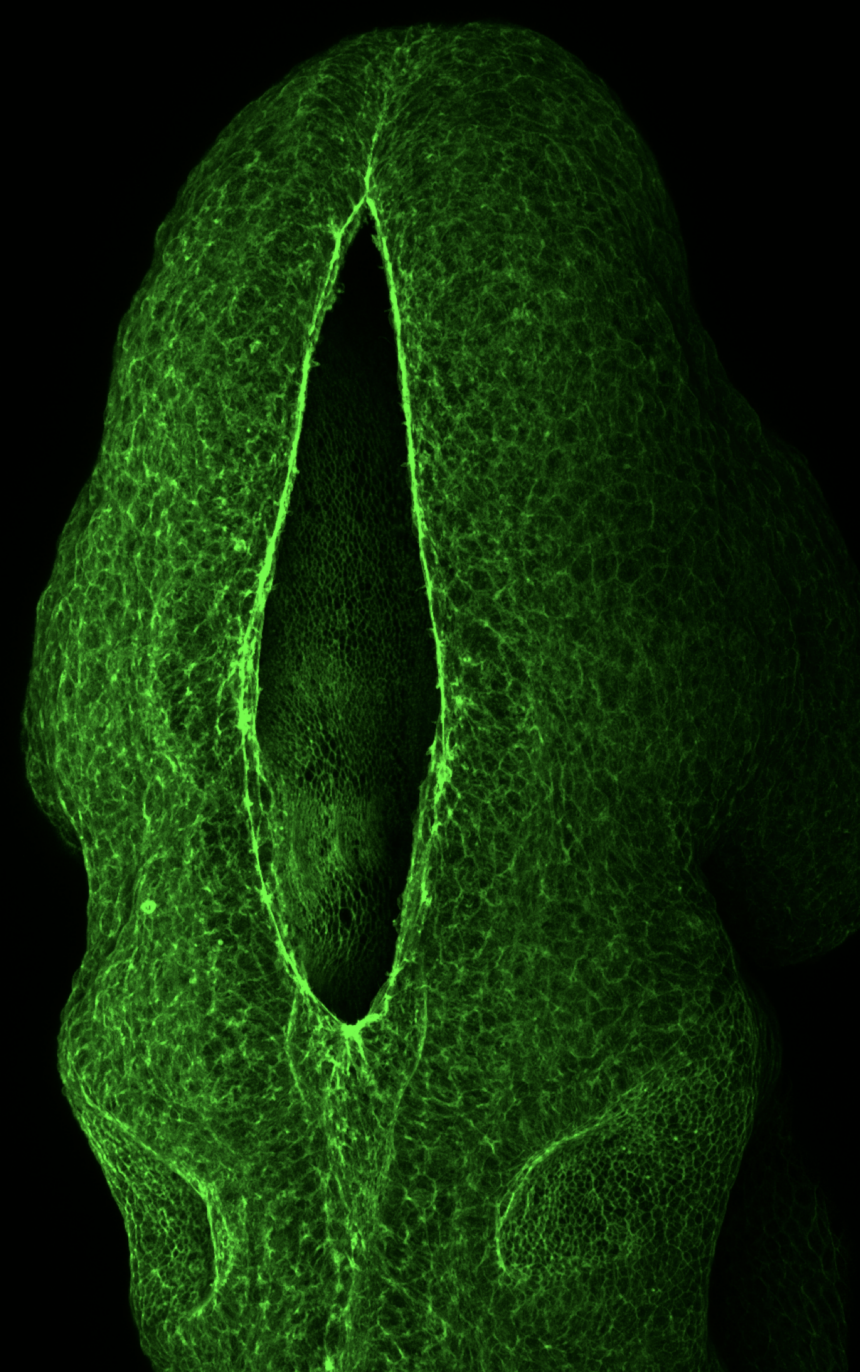
Newswise — In about one out of every 1,000 pregnancies, the neural tube, a key nervous system structure, fails to close properly. Georgia Tech physicists are now helping explain why this happens, having uncovered the physics that drive neural tube closure in a pregnancy’s earliest stages.
Working with collaborators at University College London (UCL), Georgia Tech researchers used computer models to reveal how, during early development, forces generated by cells physically pull the neural tube closed — like a drawstring. This discovery offers new insight into a critical process that, when disrupted, can result in severe birth defects such as spina bifida.
“Understanding a complex developmental process like neural tube closure requires a highly interdisciplinary approach,” said Shiladitya Banerjee, an associate professor in the School of Physics. “By combining advanced biological imaging with theoretical physics, we were able to uncover the mechanical rules that drive cells to close the tube. My lab builds computational models to uncover the physical rules of living systems. The neural tube is an ideal focus because its formation requires incredible mechanical coordination.”
The researchers presented their findings in Current Biology.
Closing the Gap
The UCL team studied mouse embryos, which develop similarly to humans, and Georgia Tech researchers used that data to construct their models. From the data, they identified the fundamental physics mechanism that enables neural tube closure in part of the brain. This mechanism, called a “purse string,” is made of actin, a pivotal protein that forms a cell’s skeletal structure. As the purse strings tighten, the tube closes.
“These actin molecules are very important because they give rigidity and shape to cells,” Banerjee said.
“During neural tube closure, actin filaments form a ring around the opening and engage molecular motors — proteins that generate forces inside cells,” he said. “As these motors pull on the actin, they generate tension that tightens the ring and draws the tube closed.”
Stretching to Fit
As the actin ring tightens, cells stretch and elongate, causing them to align and move together in a synchronized pattern, like a school of fish. This coordination allows the cells to move faster and more efficiently, increasing tension and driving a feedback loop that helps seal the neural tube.
The team built a computer model to show how this feedback loop leads to successful neural tube formation. Further research using the model could help explain why the neural tube fails to close.
“Physics-based modeling of cell and tissue mechanics allows us to connect the dots between developmental stages in a way that is both robust and quantitative, simulating experiments that are impossible in biological tissues,” said Gabriel Galea, the study co-author and UCL group leader. “In this case, it allowed us to explain how a cell’s mechanical experience impacts its current and future shapes during a critical step of brain development.”
Beyond neural tube development, the findings highlight the power of physics-based modeling to explain complex biological processes that can’t be observed directly. The researchers say this approach could be applied to other stages of human development where forces, motion, and timing are just as critical.
The computational research at Banerjee Lab is funded by the National Institute of General Medical Sciences
Fernanda Pérez-Verdugo, Eirini Maniou, Gabriel L. Galea, Shiladitya Banerjee, “Mechanosensitive feedback organizes cell shape and motion during hindbrain neuropore morphogenesis,” Current Biology, 2026.
DOI: 10.1016/j.cub.2026.02.068
Current Biology
Connecting Research and Experts with Journalists
Unlock Your Access to Newswise Research News including Embargoed News and Expert Pitches
Used only to deliver research news. Unsubscribe anytime.
Journalists use Newswise as a source for research news, experts, ready-to-use content and story ideas. Media relations professionals can connect with reporters and share their organization’s news with a wider audience. Public readers discover the latest research news in science, medicine, social sciences, environment, technology, factchecks and business news from the world’s most credible universities and research organizations. More than 7,000 email wires go to journalists from more than 2,400 media outlets around the globe.
2026 Newswise, Inc