Home → Science
It's the type of cute little tool that makes us love NASA even more.
We’ve all heard of something written in the stars. NASA being NASA, found a way to do it with our planet.
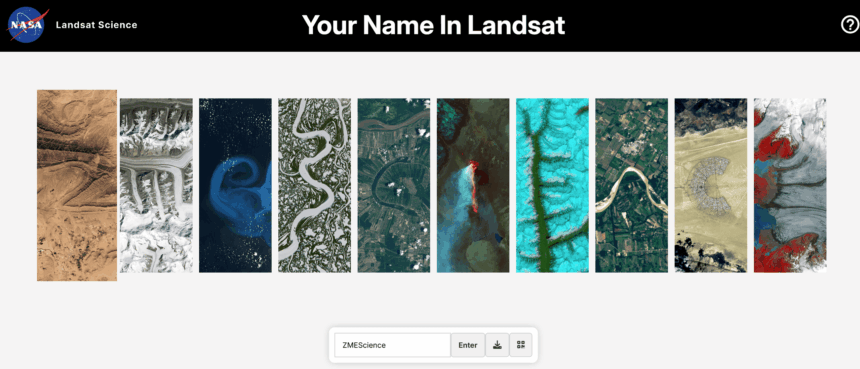
For Earth Day, the agency released a delightfully nerdy tool that lets you type in any name or word and see it spelled out in real satellite images using rivers, islands, glaciers, deserts, and coastlines that just happen to look like letters from orbit.
It’s a small, charming trick. But behind it is something much bigger: more than 50 years of Landsat imagery, a planetary archive that has watched forests shrink, cities spread, ice retreat, and landscapes change in slow motion.
NASA’s Your Name in Landsat tool does not appear to rely on just one fixed image for each letter. The tool pulls from a broader set of satellite images where rivers, rocks, currents, coastlines, or other Earth features resemble alphabet shapes. That variety is part of the charm: your “A” or “G” may not be the only one hiding on Earth, just one of many accidental letters written into the planet’s geography.
NASA says the imagery used in the tool was sourced from NASA Earth Observatory, NASA Worldview, USGS EarthExplorer, and ESA Sentinel Hub.
That matters because Landsat isn’t just a pretty-picture machine. It’s a long-running archive of Earth’s surface, tracking landscapes over decades. In this tool, you can take small bits of that massive scientific record and turn them into something personal and instantly shareable.
NASA timed the release around Earth Day, turning a global environmental moment into something personal, which is a pretty cool way to raise more science awareness. Instead of telling people to care about the planet in abstract terms, the tool lets them see Earth as a canvas.
The downloaded images are not especially large, so they are not ideal for posters or oversized prints. But that hardly ruins the charm. The point is not high-resolution wall art. The point is discovering landscapes and caring about the planet.
Stay ahead with ZME Science and subscribe.
Please check your inbox and confirm your subscription.
NASA’s tool is a reminder that public science does not always need to arrive as a dense report or dramatic warning. Sometimes, it can arrive as a name spelled in rivers and rocks.
Dr. Andrei Mihai is a geophysicist and founder of ZME Science. He has a Ph.D. in geophysics and archaeology and has completed courses from prestigious universities (with programs ranging from climate and astronomy to chemistry and geology). He is passionate about making research more accessible to everyone and communicating news and features to a broad audience.
© 2007-2025 ZME Science – Not exactly rocket science. All Rights Reserved.
© 2007-2025 ZME Science – Not exactly rocket science. All Rights Reserved.