


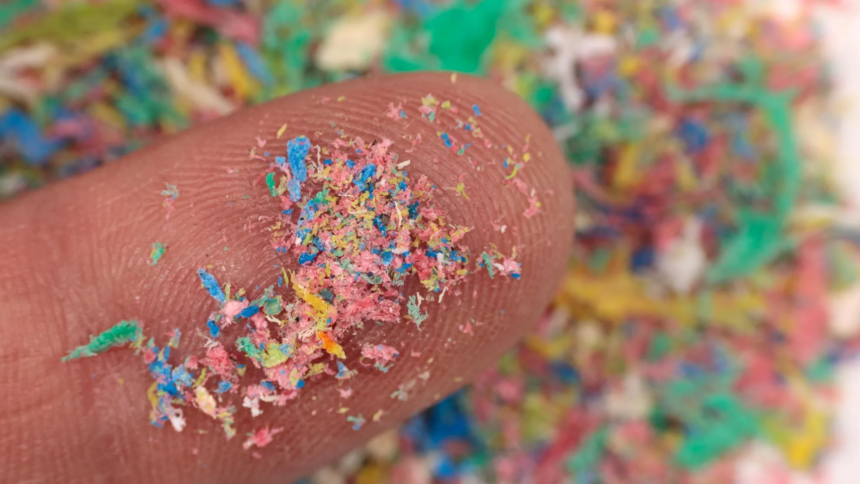
The atmosphere plays a major role in spreading microplastics across the planet, carrying these tiny particles to even the most remote regions. People and animals can inhale them, raising concerns about potential health effects. Once airborne, microplastics can also fall back to Earth, adding to pollution in oceans and soils around the world.
A new study from the Department of Meteorology and Geophysics at the University of Vienna provides a clearer picture of where these airborne microplastics come from. Using global measurements and computer models, the researchers estimate emissions from both land and ocean sources. Their key finding is striking: more than 20 times as many microplastic particles are released into the air from land than from the ocean. The study was recently published in Nature.
Sources of Airborne Microplastics
Scientists have long known that microplastics are present in the atmosphere worldwide. These particles eventually settle in distant and isolated locations. They originate from direct sources such as tyre abrasion and textile fibers, as well as from previously contaminated land and ocean surfaces that release particles back into the air.
Until now, the scale of these emissions and the contribution of each source were not well understood. Earlier research often pointed to the ocean as the main contributor, but the new findings challenge that assumption.
Comparing Models With Real-World Measurements
To better understand the problem, researchers Ioanna Evangelou, Silvia Bucci and Andreas Stohl compiled 2,782 individual measurements of atmospheric microplastics from studies conducted around the world. They then compared these real-world observations with results from a transport model that incorporated three different published emission estimates.
The comparison revealed a major issue. The model consistently predicted far more microplastic particles in the air and deposited on the Earth’s surface than were actually observed, sometimes by several orders of magnitude. This gap allowed the researchers to adjust the model and refine emission estimates separately for land and ocean sources, producing more accurate results.
Land Dominates Microplastic Emissions
After recalibrating the data, the team found that emissions from land had been significantly overestimated in earlier models, but even after correction, land remained the dominant source. Ocean emissions were also revised downward.
When asked where most airborne microplastics originate, lead author Andreas Stohl explained: "The now scaled emission estimates show that over 20 times more microplastic particles are emitted on land than from the ocean." At the same time, first author Ioanna Evangelou noted an important detail: "However, the emitted mass is actually higher over the ocean than over land, which is due to the larger average size of oceanic particles."
Ongoing Uncertainty and Need for More Data
This research marks an important step toward understanding how microplastics move through the atmosphere and spread globally. However, significant uncertainties remain.
"However, the data situation is still not satisfactory, and there are still major uncertainties. More measurements are needed so that we know how much microplastic comes from traffic and how much from other sources. The size distribution of the particles is also highly uncertain, and thus the total amount of plastic transported in the atmosphere," summarizes Andreas Stohl, lead author of the study.
Key Findings at a Glance
Story Source:
Materials provided by University of Vienna. Note: Content may be edited for style and length.
Journal Reference:
Cite This Page:
Why Popular Diabetes Drugs Like Ozempic Don’t Work for Everyone: The “Genetic Glitch”
Scientists Stunned After Finding Plant Thought Extinct for 60 Years
Drinking Alcohol To Cope in Your 20s Could Damage Your Brain for Life
Scientists Warn: Popular Sweetener Linked to Dangerous Metabolic Effects
Stay informed with ScienceDaily’s free email newsletter, updated daily and weekly. Or view our many newsfeeds in your RSS reader:
Keep up to date with the latest news from ScienceDaily via social networks:
Tell us what you think of ScienceDaily — we welcome both positive and negative comments. Have any problems using the site? Questions?
Scientists just found where airborne microplastics really come from – Science Daily



Leave a Comment