


Our Privacy Statement & Cookie Policy
By continuing to browse our site you agree to our use of cookies, revised Privacy Policy and Terms of Use. You can change your cookie settings through your browser.
CGTN
Copied
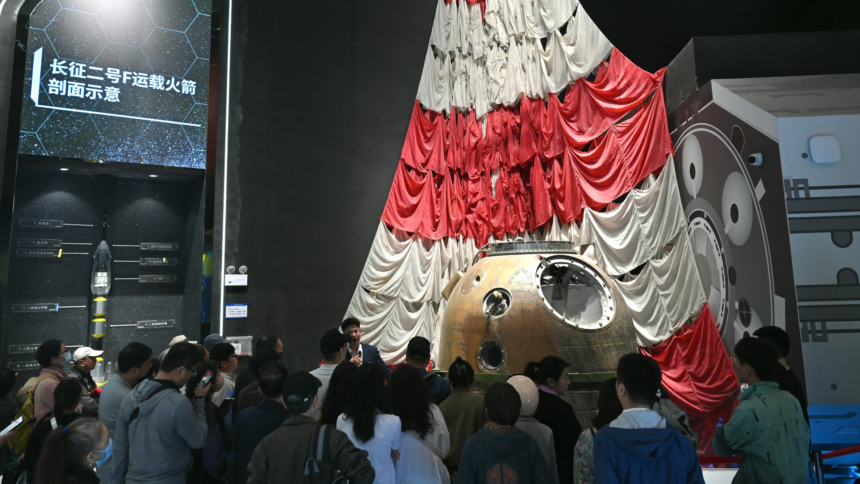
Visitors drawn to the actual Shenzhou IV return module displayed at the China Space Museum in Beijing, which offered free admission on the 11th China Space Day on April 24, 2026. /VCG
China marked its 11th Space Day on Friday, with an aerospace science exhibition in Chengdu, Sichuan Province, kicking off the celebrations. China’s space program, which started in 1956, has been making steady progress. Now entering its eighth decade, it is expected to make history for both China and global cosmic exploration endeavors.
Fifty-six years ago, on April 24, 1970, China launched its first satellite, Dongfanghong-1. The spherical-shaped satellite orbited the Earth for 28 days, making China the fifth nation to independently launch a satellite.
That date was chosen to be China’s Space Day in 2016, 46 years after the satellite transmitted the song Dong Fang Hong across the globe. Within less than half a century, China launched its first crewed spaceflight, landed on the moon and launched its first space lab, paving the way for the Tiangong space station.
Another decade has passed since China’s first Space Day, and the country’s space program has been making steady, all-around progress.
2025: a year of progress for China’s space program
China conducted 92 orbital launches in 2025, breaking the previous national record set in 2024 by 35%. Most of those launches were for constructing the nation’s mega-constellations of low-Earth-orbit internet satellites, including GuoWang, a state-backed constellation with nearly 13,000 satellites, and SpaceSail, a commercial venture led by Shanghai Spacecom Satellite Technology.
China’s crewed spaceflights also set records, with the Shenzhou-20 crew having remained in orbit for 204 days, the longest single mission in China’s crewed spaceflight history.
China also conducted its first-ever successful emergency launch in November last year. On November 5, one day before the Shenzhou-20 crew’s scheduled return, astronauts reported a crack along the edge of the return capsule’s window, likely caused by impact from space debris.
Shenzhou-22 spacecraft docking with China’s Tiangong space station on November 25, 2025 /China Manned Space Agency
The return capsule was deemed unsafe for reentry, which requires the capsule’s viewport to withstand temperatures exceeding 1,000 degrees Celsius caused by atmospheric friction.
The crew instead returned to Earth using the return capsule of the recently arrived Shenzhou-21 spaceship. To avoid leaving the crew of Shenzhou-21 stranded in orbit, China National Space Administration (CNSA) launched Shenzhou-22 in just 16 days, providing a return vehicle for the astronauts.
CNSA also tested spacecraft and launch vehicles for the country’s crewed lunar landing. In 2025, China successfully implemented the zero-altitude escape flight test for the Mengzhou crewed spacecraft, the landing and takeoff verification test for the Lanyue lunar lander and the tethered ignition tests for the Long March 10 series launch vehicle.
Deep-space exploration also made steady advancement in 2025. Tianwen-2, China’s second planetary exploration mission, was launched in May. This ambitious, decade-long mission will collect and return a sample of a near-Earth asteroid in 2027 and survey a main-belt comet in 2034.
Prepping for the next decade: foot on the moon, rocks back from Mars
The eighth decade of China’s space program will see some major milestones in the country’s and the world’s space exploration history.
Tianwen-3, a Martian probe designed to return soil and rock samples from Mars, will be launched in 2028. It could become the first human probe to return samples from the red planet, according to Liu Jizhong, the chief designer of the Tianwen-3 mission. So far, all human-launched Martian probes have stayed on Mars or in its orbit.
China conducts a low-altitude demonstration and validation flight test of the Long March-10 launch vehicle system at the Wenchang Space Launch Site in south China’s Hainan Province, February 11, 2026. /China Manned Space Agency
Chinese astronauts are expected to land on the moon by 2030, while construction of the International Lunar Research Station in the lunar South Pole is being planned.
With the low-altitude demonstration and validation flight of China’s Long March 10 lunar rocket and the Mengzhou spacecraft successfully concluded in February, 2026 will be a crucial year for China to gain an edge in the race with NASA to return to the moon.
Read more:
China Space Day: How far have we come toward a manned lunar landing?
China's space program enters its eighth decade with steady progress – news.cgtn.com



Leave a Comment