


Preston
More in
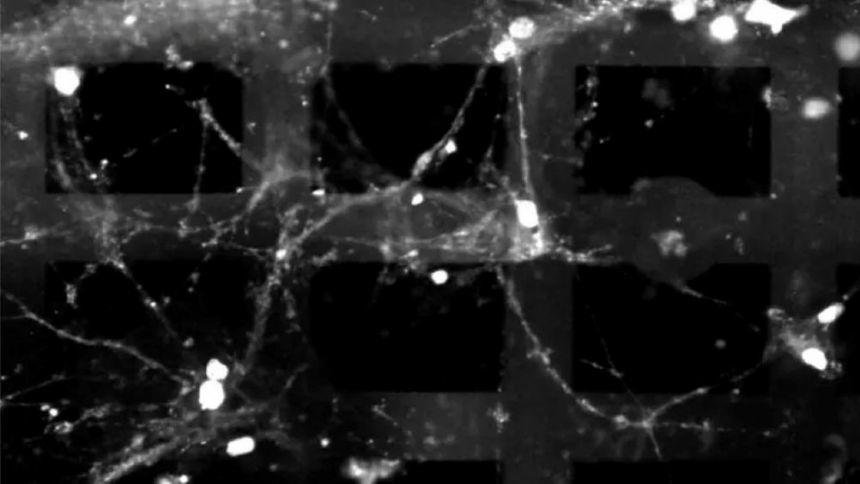
Researchers at Princeton University have developed a three-dimensional bioelectronic device that integrates living brain cells with embedded circuitry to perform pattern recognition tasks.
The system combines neural tissue with a microscale electronic framework, enabling computation within a three-dimensional structure rather than relying on conventional two-dimensional cell cultures grown in a petri dish or externally monitored clusters. The work is detailed in Nature Electronics.
The device is built around a mesh of microscopic metal wires and electrodes, coated with a thin layer of epoxy designed to match the flexibility of biological tissue.
This structure acts as a scaffold, allowing tens of thousands of neurons to grow around and within it, forming a dense 3D neural network.
By embedding the electronics within the network itself, the researchers were able to directly interact with the neurons at a finer level than in previous approaches.
According to the research team, this internal integration allowed more precise recording and stimulation of neuronal electrical activity over extended periods.
They tracked the evolution of the system over a period of more than six months, experimenting with ways to strengthen and weaken connections between key neurons, and ultimately trained an algorithm that could recognise patterns of electrical pulses.
Using these adjustments, the researchers trained the system to distinguish between different patterns of electrical signals. In testing, the device successfully identified spatial and temporal input patterns, demonstrating its ability to process and classify information. The team indicated that further development could enable the platform to handle more complex computational tasks.
The project was led by Tian-Ming Fu, James Sturm, and Kumar Mritunjay. The work initially focused on advancing understanding of neural systems but has implications for computing technologies.
“The real bottleneck for AI in the near future is energy,” said Fu. “Our brain consumes only a tiny fraction – about one millionth – of the power consumed by today’s AI systems to perform similar tasks.”
Mritunjay, the paper’s first author, said that systems such as 3D biological neural networks can provide insight into how the brain processes information while also contributing to research into neurological conditions.
If by ′support′ you mean removing some of the many financial and regulatory constraints imposed BY government ONTO manufacturing, then YES!
I actually don′t begrudge them the public-funded £3.6 million grant for this project – as a proof of concept. I do disagree that this specific…
Got it – so they are constantly charging and discharging ′on the go′. Thanks
3D bioelectronic brain cell device advances AI research – The Engineer – Home



Leave a Comment