


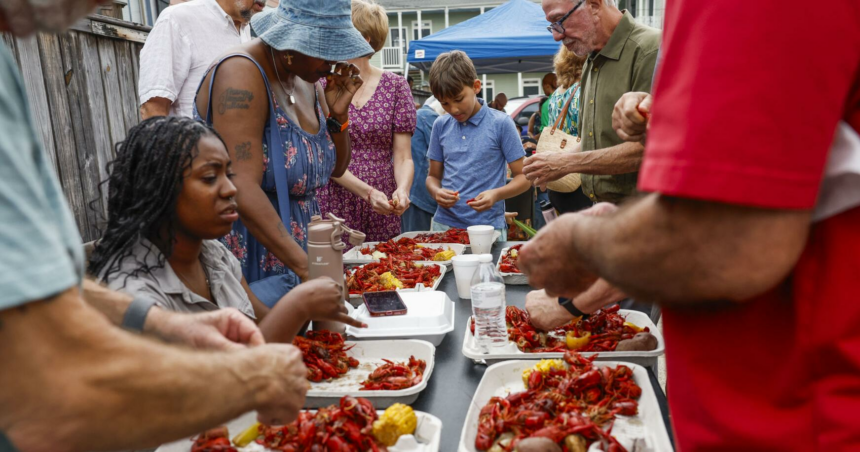
Saint Anna’s Episcopal Church holds their annual Palm Sunday crawfish boil after mass in New Orleans, Sunday, March 29, 2026. (Photo by Sophia Germer, The Times-Picayune)
“Crayfish, Crawfish, Crawdad: The Biology and Conservation of North America’s Favorite Crustaceans” by Zachary A. Graham, The University of North Carolina Press.
Author Zachary A. Graham
Sacks of crawfish fill a truck bed by a crawfish pond during a harvest near Eunice, Louisiana Friday, March 27, 2026. (Staff photo by David Grunfeld, The Times-Picayune)
A crawfish boat works a crawfish pond near Eunice, Louisiana Friday, March 27, 2026. (Staff photo by David Grunfeld, The Times-Picayune)
Saint Anna’s Episcopal Church holds their annual Palm Sunday crawfish boil after mass in New Orleans, Sunday, March 29, 2026. (Photo by Sophia Germer, The Times-Picayune)
“Crayfish, Crawfish, Crawdad: The Biology and Conservation of North America’s Favorite Crustaceans” by Zackary A. Graham, The University of North Carolina Press, 232 pages.
As crawfish season winds down in Louisiana, my thoughts often turn to what the crustaceans do the rest of the year. Do they miraculously grow into lobsters? Or do they plot to invade Breaux Bridge, the Crawfish Capital of the World? Maybe they just hang out in the mud, fattening up, so I can eat them the following season?
I can’t think of a better entry point to sate my appetite for crawfish questions than Zackary A. Graham’s “Crayfish, Crawfish, Crawdad,” an illuminating overview of those humble but mighty crustaceans that, though certainly science-oriented, is accessible to a wide readership.
First, a note on the book’s triple-tail of a title, a linguistic conundrum that Graham, a biology professor at West Liberty University in West Virginia, succinctly simplifies: “If you are studying them, call them crayfish; if you are using them as fishing bait, call them crawdads; and if you are eating them, call them crawfish.”
Author Zachary A. Graham
Here in Louisiana, calling them “crayfish” — whether dead, alive or dangling from the end of a hook — sounds, well, cray, and will likely get you laughed out of an otherwise friendly backyard boil. But in deference, I’ll stick with Graham’s nomenclature, while leaving room for some other crayfish nicknames used in scattered pockets around the nation.
People no doubt know “mudbug,” a common term for burrowing species, as opposed to the many crayfish that seek shelter under rocks in streams and rivers. Care to sample a tray of spicy “ditch crickets”? “Pond lobsters” certainly sounds more appetizing, but I’m holding out for an order of hot, boiled “crawcrabs,” which sounds like a seafood that Cajuns haven’t gotten around to inventing yet.
Over 700 crayfish species have been identified on this planet, found in freshwater sources on every continent except Antarctica and mainland Africa — though Madagascar hosts seven species local to the island. North America is crayfish heaven, home to over 400 native species, from the Least Dwarf Crayfish, a one- to two-centimeter-sized cutie that lives in Mississippi and Alabama, to the five- to eight-inch whopper known as Barbicambarus simmonsi (it’s endangered, so don’t go fishing the creeks of Tennessee looking for something to toss into the pot.)
“Crayfish, Crawfish, Crawdad: The Biology and Conservation of North America’s Favorite Crustaceans” by Zachary A. Graham, The University of North Carolina Press.
“Learning about crayfish is more of a crawl than a climb,” Graham puns, but he informs with ease.
Despite their buggy-eyed, armor-plated, alien-antennaed aesthetic, crayfish are just like us! Sort of. They’re one of the only animals to copulate face-to-face, often engaging in a little claw-tap foreplay, followed by some more serious roughhousing, before collapsing in a missionary-style heap.
Despite being aggressive and “unrelentingly territorial,” mud-burrowing crayfish like the Red Swamp Crayfish, aka the Louisiana Crawfish, are more semi-communal than solitary. Those mud chimneys lead to a system of tunnels and chambers that one researcher calls “party burrows,” where crayfish often cohabitate with a host of aquatic and semi-aquatic creatures: fish, snakes, insects and the aptly named Crawfish Frog, “the most secretive amphibian in North America.”
Due to its global prevalence, the crayfish has long been a significant subject of study for biologists, from Thomas Henry Huxley, nicknamed “Darwin’s bulldog” for his ruthless defense of evolutionary theory, to Horton Holcombe Hobbs Jr., the godfather of modern astacology, who kept an aquarium in his college dorm room and became the first to document crayfish coitus.
Sacks of crawfish fill a truck bed by a crawfish pond during a harvest near Eunice, Louisiana Friday, March 27, 2026. (Staff photo by David Grunfeld, The Times-Picayune)
Today, scientists see the crayfish as a model organism, a cornerstone of biological research, used in drug trials and, because its neural architecture mirrors our own, experiments into what makes our brain operate. Biologists also consider the crayfish a prime bioindicator, an organism that can reveal the health of its ecosystem.
Unsurprisingly, many crayfish habitats are in trouble. Half of all North American crayfish species require conservation attention, making the mudbug one of the world’s most threatened animal groups.
It’s likely too late for the Sooty Crayfish, a presumably extinct species that once crawled the creeks surrounding San Francisco Bay and a favorite source of protein for 19th-century gold rushers. If not for recent conservation efforts, its closest cousin, the endangered Shasta Crayfish, might soon join it in mudbug heaven. Blame urbanization, pollution and a third close relative, the Signal Crayfish, a highly aggressive, frequently cannibalistic super-breeder that has become an invasive menace not just in California but Europe.
As he details the hidden life of crayfish, Graham wisely shares stories from his own fieldwork experience — confused locals watching him fist-plunge mudbug holes is a highlight — while leaving room for snapshots of the world’s more unique species.
A crawfish boat works a crawfish pond near Eunice, Louisiana Friday, March 27, 2026. (Staff photo by David Grunfeld, The Times-Picayune)
Behold the Digger Crayfish, a leopard-spotted beauty, and the electric neon wonder that is the Blue Crayfish. The book contains color photographs of each, as well as many others.
There’s some real mudbug mind-bogglers, like the well-named Virile Crayfish, a mega-mama of a crustacean capable of carrying more than 500 eggs under its abdomen at one time, and the Marbled Crayfish, which breeds via virgin birth. The Spider Cave Crayfish of Florida, with an antennae span nearly three times its body length, will haunt my nightmares in the short term.
And cast your eyes on North America’s largest burrower, the Crawzilla Crawdad — yes, that’s its actual common name — which stomps the flood plains of the Ohio River Basin and, despite its fierce moniker, is a bit of a softie.
Before you invite Graham over for a boil, a fair warning: he’s deathly allergic to shellfish. Yet, he’s written a book to bring to your next crawfish boil, one that will have you spouting factoids to friends while combing its pages with cayenne-spiced fingers.
Rien Fertel is the author of four books. He can be reached at rienfertel@gmail.com.
News Tips:
newstips@theadvocate.com
Other questions:
subscriberservices@theadvocate.com
Need help?
Your browser is out of date and potentially vulnerable to security risks.
We recommend switching to one of the following browsers:
'Crayfish, Crawfish, Crawdad' book highlights the humble but mighty crustaceans – The Advocate


Leave a Comment